
‘Speaking Stones’ by Carla Vetere
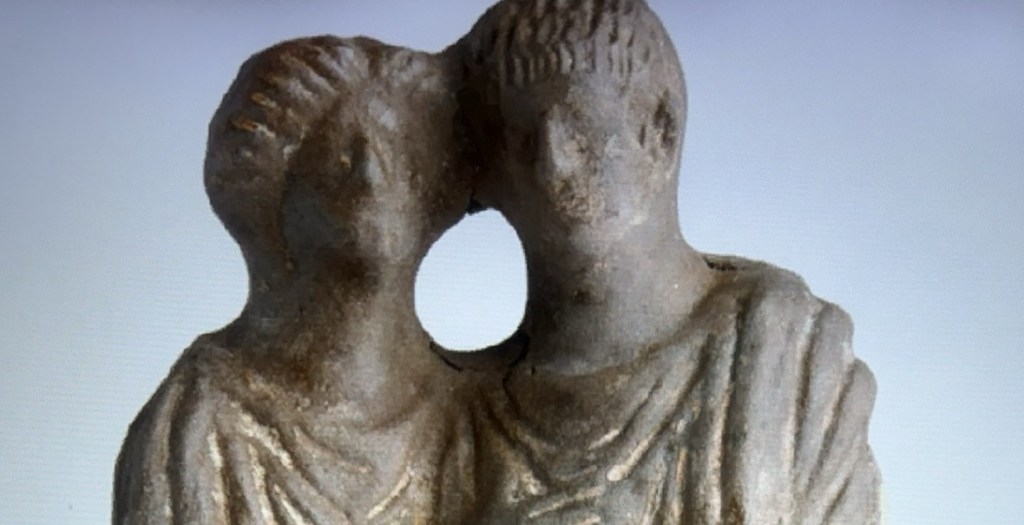
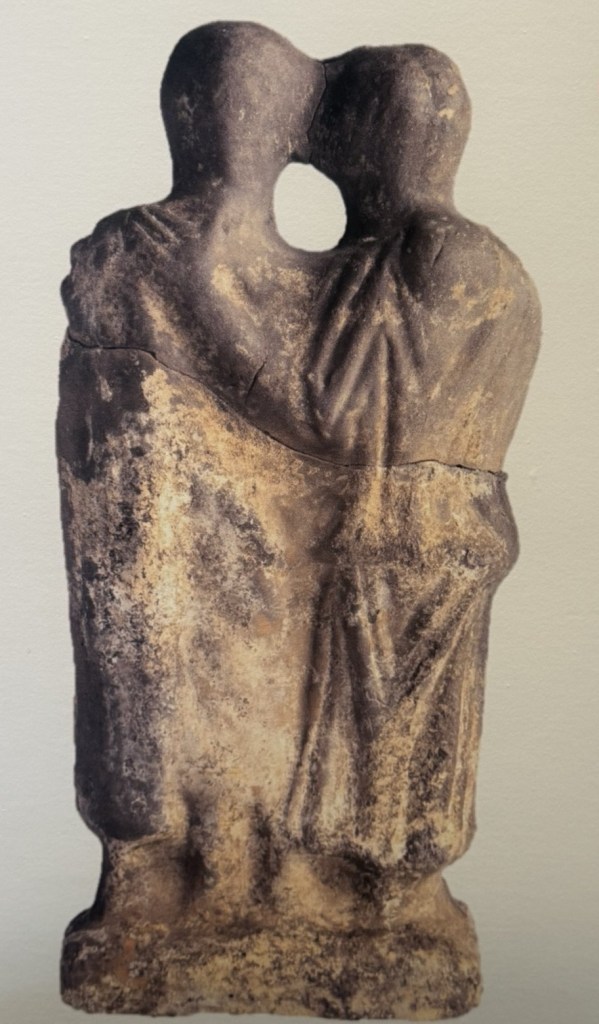
The Civic Museum “Guido Sutermeister” in Legnano, in western Lombardy, houses a small treasure from the 1st century AD: a terracotta hollow figurine found during excavations in 2015 in a tomb in Pogliano Milanese.

The statuette is approximately 6.5 inches tall, 3 inches long, and 2 inches wide. It is orange with signs of blackening due to having being placed on a pyre along with the bones of its owners, who were cremated in the so called ustrinum.
The statuette was found in two separate pieces kept in different layers of a funerary urn, that has itself a singular shape: in fact, it is made up of the back of two different amphorae, so that one forms the lid of the other. There are four levels in the urn: the surface level is the first, the lowest level is the fourth. The upper part of the pottery was found in the third level, the oldest, while the lower part was in the first, more recent level.
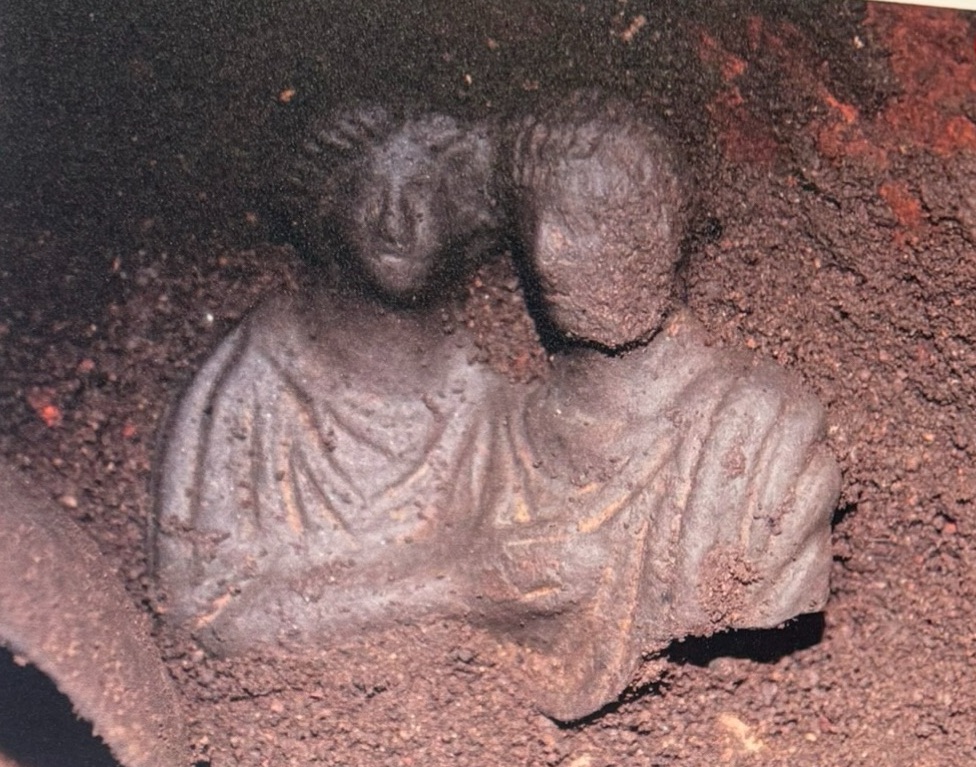
At the beginning of excavation, several fragments were missing, but luckily the largest gap, with the arm and hand of the man holding a scroll, was found by sifting through the excavated earth delivered to the Museum by the Superintendency of Archaeological Heritage. Several objects were also found around the urn, including two coins that allow us to better date the find: one from the age of Augustus ( (27 BC- 14 AD) the other from the age of Caligula (37-41 AD). There was also a small bronze brooch with the word “Legio”.
Although clay figurines are common in Roman excavations, there are very few of them found in Cisalpine Gaul. Additionally, this statuette has been recognised as a unique in the Olona Valley area.
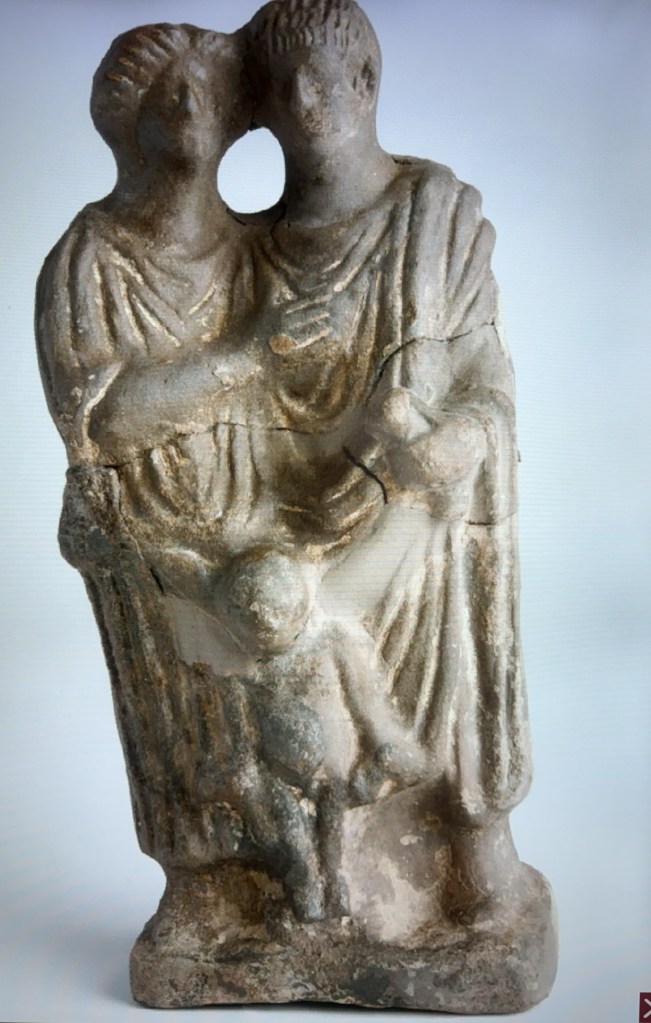
The image shows a couple standing with a child in front of them. The figures are tightly joined, except for the necks of the two adults that are separated. All faces appear stylized. The woman is on the right: she wears a simple tunic, trimmed on both the front and back of the statue, and has parted hair in the centre; she holds her right arm on her partner’s chest; her left arm surrounds the other figure, where her hand, firmly anchored to her partner’s left shoulder, is clearly visible.
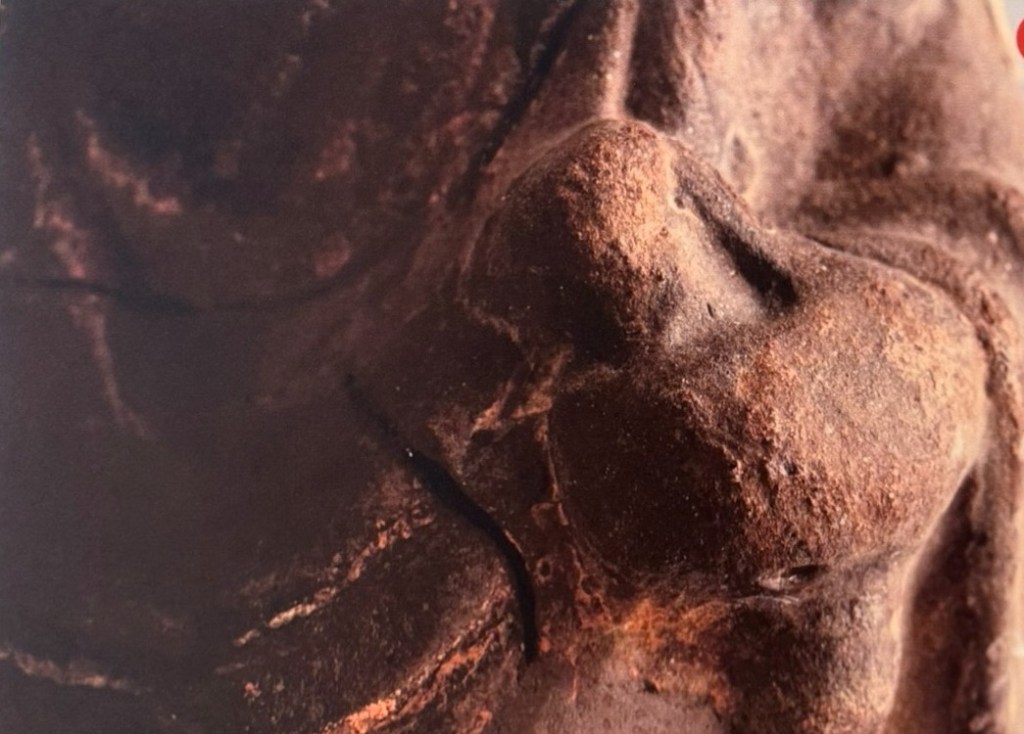
The man has short hair, is dressed in a toga, which covers him almost completely, and has a scroll in his right hand; on his feet he wears calcei, the typical Roman footwear: in short, it bears all the iconographic characteristics of a free man with a good social position; his right arm and hand are not visible but are presumably behind the child who is in front of the couple, naked, with hands lowered to hold the adults’ clothes. The child has presumable wings. The stylization is very evident and is typical of ex-votos from the Republican era onwards: in fact, a fusion of realistic traits and typological elements is frequent to represent the role of the character in the community, they embody positive values, social position and a beautiful family.
The ex-votos in effect had a dual function: they were an offering to the deity but also a means of self-representation. In a society with a strong and effective social mobility, distinctive status marks in clothing became very important even among the non-elitist classes, and the toga played a key role in this context.
In addition to the social role in the local community, this small image tells the story of a happy couple: a woman embraces her partner, the love of her life, presumably a Roman soldier from a legion stationed in the Olona Valley. The scroll he holds in his hands suggests that this soldier played a significant role in his community.
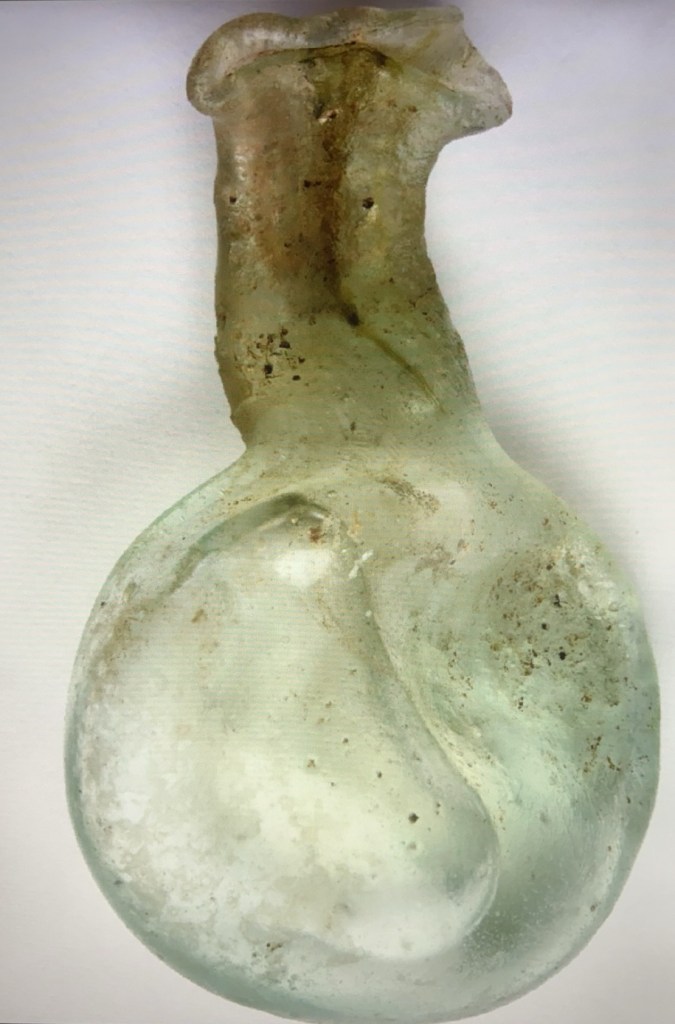
The couple must have been quite comfortable judging by the numerous glass balsams of excellent workmanship found in the burial. One of them seems to reproduce a face and still contains residues of a liquid that have not yet been identified. Lamps (lucernae) with beautiful decorations accompanied the funeral trousseau.
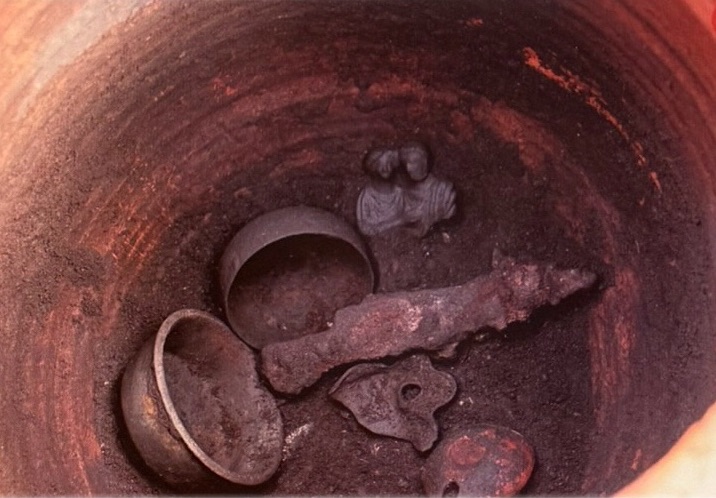
The couple’s belongings, including a knife and a quadrangular mirror, have also been found in the urn.
The couple probably had a kid, depicted with wings, perhaps indicating that this young life was the angel of the family. We do not know the woman’s origin, but we know from epigraphs in that area that marriages between Romans and local women were frequent, so this young woman is not necessarily of Roman origin.
The two probably died at two different times: in fact, the statuette is “defunctionalized” because it was broken into two parts. It is likely that each of the two parties was placed in the family urn at the time of each spouse’s death.
We will never know who died first, nor whether they really had a child or whether that child who still wears the two characters’ robes is just a little Eros, the embodiment of the love that bound them inextricably throughout their lives. Their history is similar to that of many others, even those described by classical mythology, but at the same time it is unique because, thanks to the patient work of archaeologists, it was removed from oblivion and returned to our gaze 20 centuries later.
The bodies of the two spouses, united by their common love, one heart beating in two bodies, became one in life and death and as such they wanted to be presented to their posterity, depicted in a simple pottery statuette, and thus entrusted their story and their common destiny to Eternity.
Carla Vetere is a teacher of Latin, Greek History and Geography at High School in Lombardy. Palaeographer and Archivist, she is interested in Ancient and Medieval History, and in Rhetoric. She is a board Member of Italian Classical Association, founded in 1897 (AICC Associazione Italiana di Cultura Classica); and a member of Classical Association UK, Classical Association of Northern Ireland.
Among her books:
Cicero from the past to the future. Culture and Politics in Cicero’s De Oratore (Amazon eBook / Milan 2020)
Il potere della parola dal passato al presente. Cicerone tra humanitas e civitas (Amazon ebook / Milan 2026)
 Italy as the Romans did
Leave a comment