
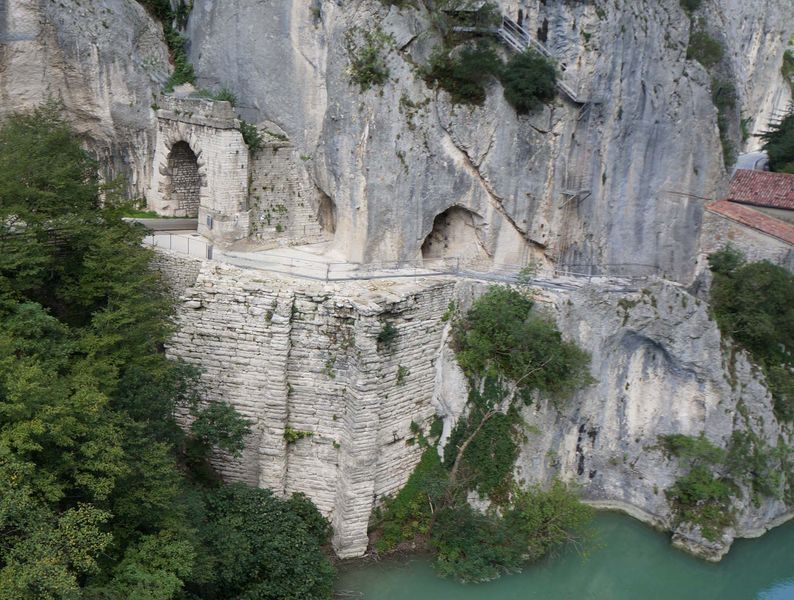
THE FURLO TUNNELS – The Furlo Pass, on a spectacular gorge in the region of Marche that is dubbed the ‘Grand Canyon of Italy’, represented the greatest challenge for Roman engineering along the route of the Via Flaminia. The consular road, which connected the Tyrrhenian to the Adriatic Sea, winds through the passes of the Apennines and along the main valleys.
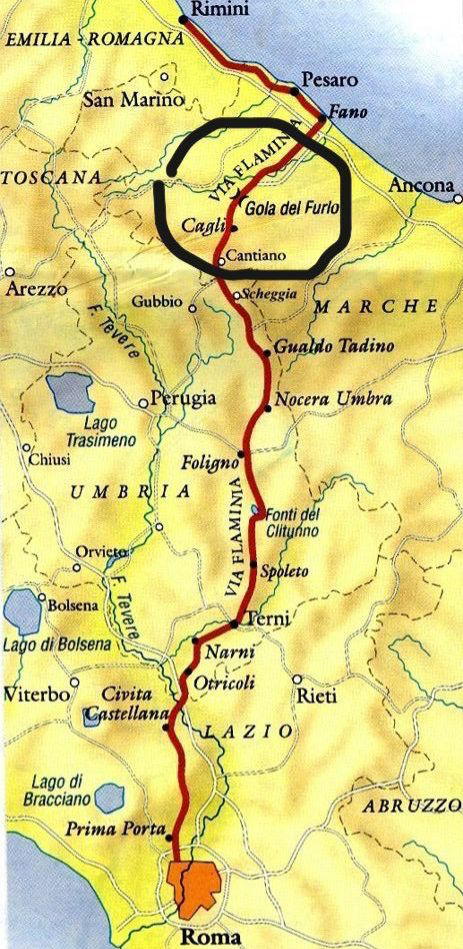
The most difficult point to overcome was the Furlo Pass where they had to build imposing substructures and a bridge and to dig a tunnel into the hard and compact rock of the Massive Limestone (formation consisting of metric-thick banks). What was realized is one of the little ‘miracles’ for which Roman engineers and workers are still famous.
THE VIA FLAMINIA – The road derives its name from Gaius Flaminius: around 220 BC he promoted the construction of a road that connected Rome to the Adriatic Sea at Fanum Fortunae (Fano, SEE OUR GEMS section) and then to Ariminum (Rimini).
The route wound from south-west to north-east on a territory that put Roman engineers great skills to the test, especially to join the part that followed the Tiber Valley with the Burano Valley, having to overcome the treacherous Scheggia pass and then, along the Candigliano Valley, to surmont the obstacle of the narrow and impervio Furlo Gorge.
At Furlo the original route followed a path about 80 metres above the bottom of the gorge that was widened so that the road could pass outside the entire rock spur. This required “terracing” walls to support the road called substructures: they extended for a length of 20 meters and reached a maximum height of almost 30 meters, today partly submerged by water.
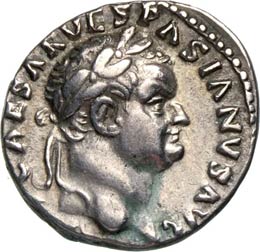
The Flaminia was later improved by consul Tiberius Sempronius Gracchus (in 177 BC), by Augustus (27 BC) and by Vespasian (76-77 AD) with the excavation of a large tunnel that was an extraordinary achievement for the Ancient world.
THE VISIT – The Furlo Gorge is divided between the municipalities of Fermignano and Acqualagna. It is usually quite easy to find free parking at the Furlo Gorge: there are three car parks at the gorge and one further away. For those arriving from the town of Acqualagna the closest is the one at the Bar Furlo, but only customers can park there. If you arrive from Fossombrone, there is a free car park just before the tunnel. Another parking is right at the gorge. If they are all full the alternative is
to walk 1.5 km from the parking in front of the Birra al Pozzo hotel restaurant.
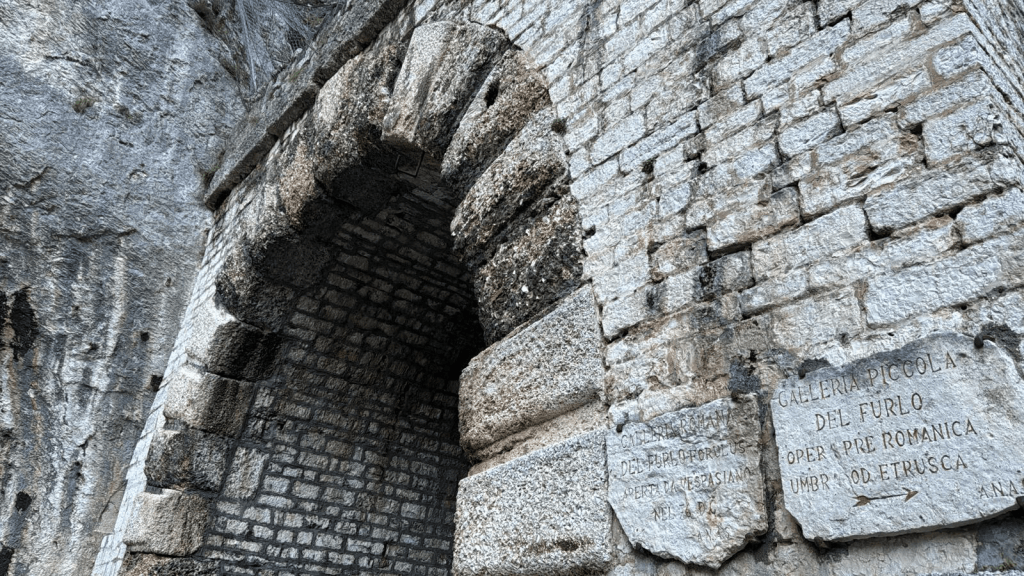
THE SMALL TUNNEL – The first tunnel, not easily datable, is thought to have been opened a century or so before the other: it was initially attributed to local Umbri but now there is a consensus that it was more likely realized by Romans, possibly under Augustus.

It measured 8 meters in length, 3.30 in width and 4.40 in height. The small tunnel is irregular in shape and it was barely suitable for the passage of one cart at a time.
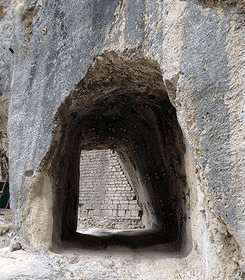
It was created as a result of an emergency intervention together with the adjacent terrace wall, which reinforces its structure, probably at risk, located on the edge of the crumbling cliff.

This small and perhaps precarious tunnel provided a narrow emergency passage for the Via Flaminia to bypass the steep side of the cliff that had previously collapsed. The tunnel has irregular chippings in connection with the two entrances, made with a chisel on the walls carefully cut vertically.
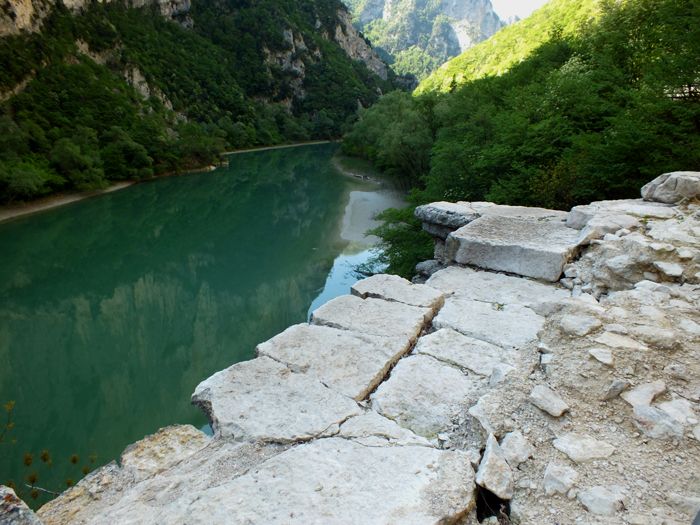
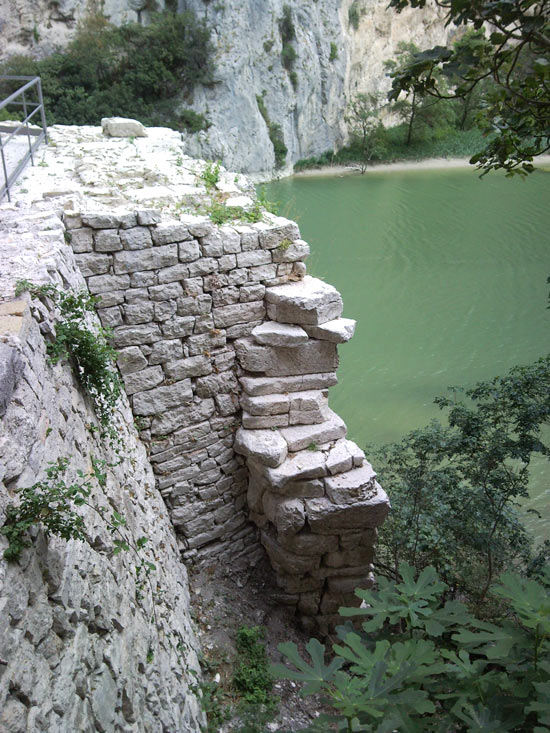
With the opening of the large tunnel, the original route of the road that bypassed the cliff was abandoned, having also become almost unusable at the time.
THE MAIN TUNNEL – Subsequently, Vespasian, mindful of the difficulties encountered by his army in crossing the Furlo with snow and ice when travelling with his troops from Jerusalem to be crowned Emperor in 69 AD, decided to make the passage easier by having another tunnel dug, next to the small one. It took five years to excavate it and when it was inaugurated, in 76 AD, it allowed a greater transit of people and vehicles.

On the north-east entrance there is the original inscription celebrating its construction: IMP. CAESAR AUG. – VESPASIANUM PONT. MAX – TRIB. POT. VII IMP. XVII PP. COS. VIII – CENSOR FACIUND CURAVIT (the last rod is probably added).

The passage, still used, is 38.30 m long, 5.47 m wide and about 6 m high and was dug into the compact limestone. It allowed the passage of carta in both directions at the same time.
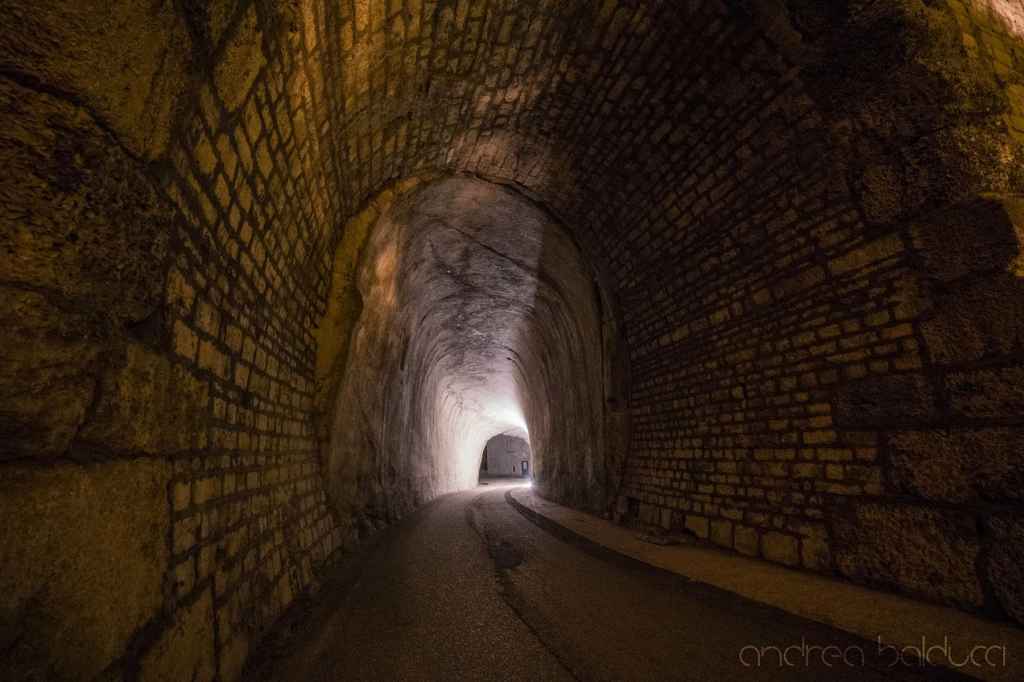
The excavation of the boulder was executed by two teams digging on both sides with modest means, such as pickaxes, hammers and wedges. Inside the gallery one can still clearly see the traces left by these tools both on the walls and on the vault, carefully made uniform.
The gallery was first called Petra Pertusa, then Forulus and finally Furlo.
The tunnel proved to be crucial, because the harsh gorge could only have been avoided with a very long detour all in a high hill area, with considerable difficulties to overcome. Roman roads generally adapted to the topographical characters of each territory and thus use existing environmental elements such as ridges, passes and bottlenecks. The exceptional result achieved, however, justifies the use at Furlo of an alteration of the landscape that Roman engineers generally avoided.
CHIAVICOTTO – Near the gallery you can see the Chiavicotto, a fascinating water tunnel built by Romans to allow the water to flow down from the mountain directly into the river, avoiding the risk of flooding the road.
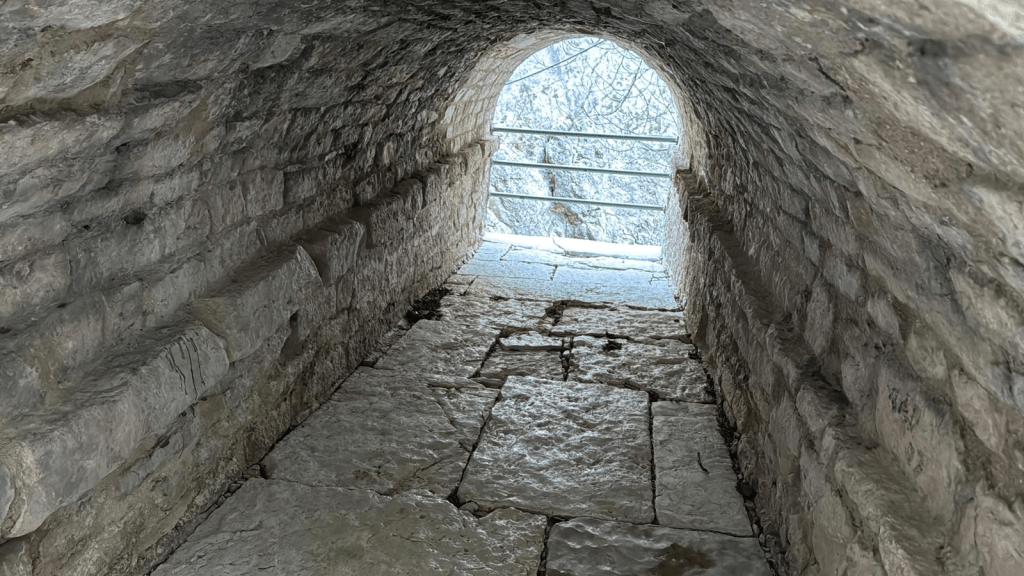
The drainage channel, about 7 m long and 1.70 m wide, is made with a barrel vault, the upper part of which is however the result of a modern renovation. The original structure of the monument can be recognized in the lower part, in particular in the part of the mountain downstream where the water discharges, characterized by a stepped semi-circle that allows greater support for the wall and facilitates the flow of water.
THE ANTIQUARIUM OF ACQUALAGNA
At 5 km from the Furlo pass you can visit Acqualagna, known worldwide for its production of nine types of fresh truffle. The White Truffle Festival is held between October and November but there are events throughout the year.
Truffles were considered the food of the gods in ancient Rome: they were cooked under the ashes and eaten with honey. In Acqualagna was born Enrico Mattei, the founder in 1953 of Eni (Ente Nazionale Idrocarburi), a multinational energy company created by the Italian State of which Mattei himself was president until his death in a suspicious plane crash, for almost a decade. The house where he was born in town hosts a museum dedicated to him.
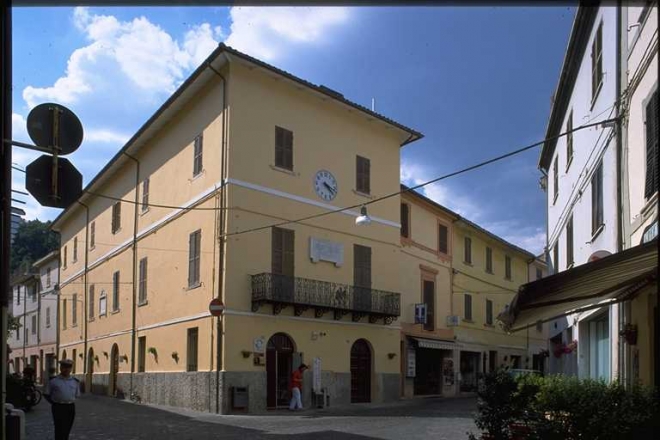
In the nice town of Acqualagna don’t miss the small but very interesting Antiquarium of Pitinum Mergens in Corso Roma,47 (Website: http://museotartufoacqualagna.it Opening hours: Saturday 15:30-18:30, Sunday 10:00-13:00 and 15:30-18:30)

The museum, built in 2003 and renovated in 2022, is housed inside the old Town Hall, in a building dating back to the 16th century. It describes the Roman territory of the ancient city of Pitinum Mergens – a site identified, but never excavated, in the near Pole-Pian di Valeria area – and it reveals the daily life of a nearby Roman Republican villa in the Colombara area. The villa was excavated in 1995 and 1996 but it is not open to the public.
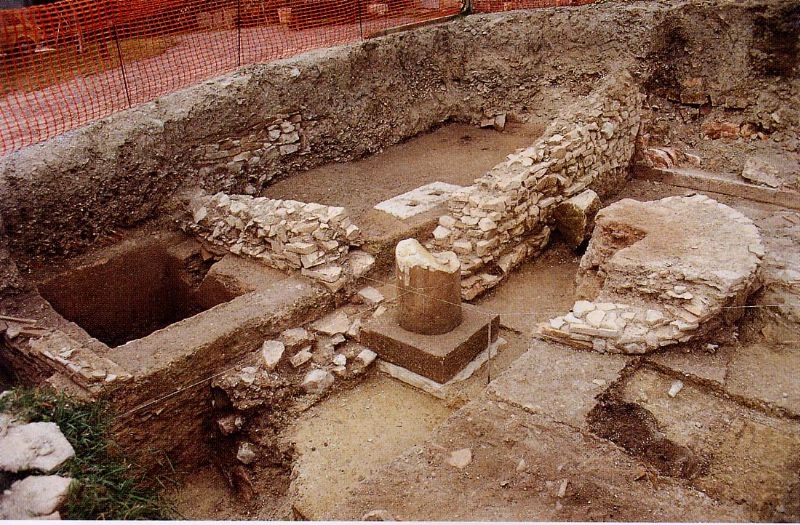
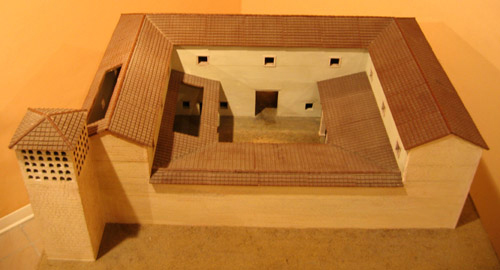
The Roman farm of Colombara, which takes its name from a tower where pigeons were raised to be eaten or used as messengers. The rustic villa was built at the beginning of the 2nd century BC and used until the end of the 1st century BC. The archaeological site is located 400 meters north of the Via Flaminia, on the edge of the alluvial plain and in correspondence with a slightly raised place near a perennial spring.
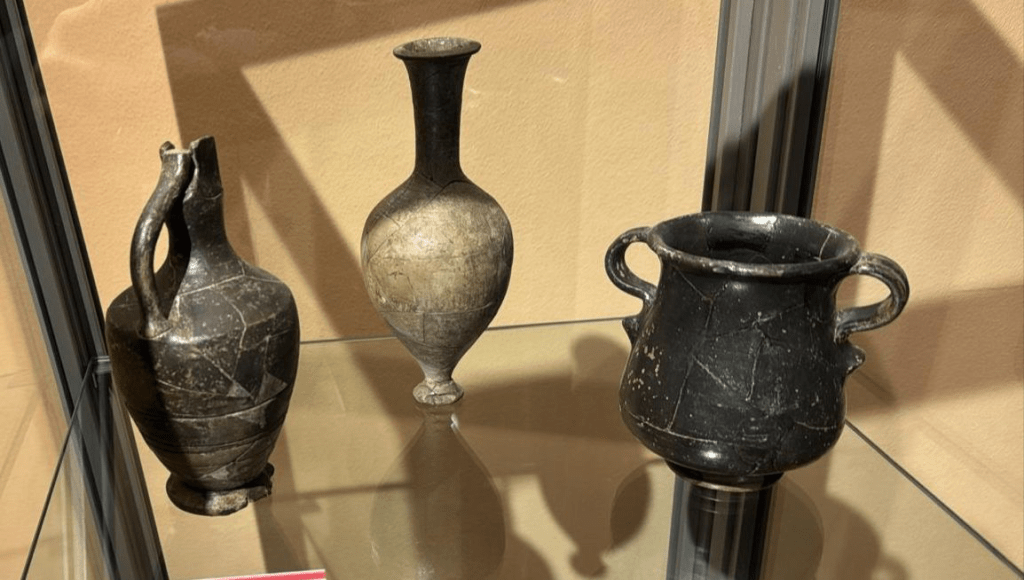
The Villa represents a very fortunate case of recovery of materials. In fact, after the collapse caused by a fire, many objects have arrived intact. Iron agricultural tools are preserved in the rooms: a dozen large sickles as well as axes, wedges, knives, tools of various types and rings of various sizes for harnesses of oxen and horses. There are several stones for sharpening cutting tools. The pottery is significant, mostly whole and with black varnish, attributable to life in the villa between the 3rd and 1st centuries BC: plates, cups, jugs, as well as containers of various types, amphorae.
Don’t miss the most important and precious objects on display: three dolia with remains of charred cereals and legumes inside, a real Roman meal that seems to have been just cooked!

There is also a reproduction of the Via Flaminia from the Tabula Peutingheriana, an illustrated ancient Roman road map copied in 1200 (it is kept in the Vienna Library) showing the layout of the road network of the Roman Empire.

PITINUM MERGENS – Archaeologists and historians have tried for centuries to locate the municipium of Pitinum Mergens, the Roman city in the Furlo area that was inhabited from the late Republican era to the late antique era.
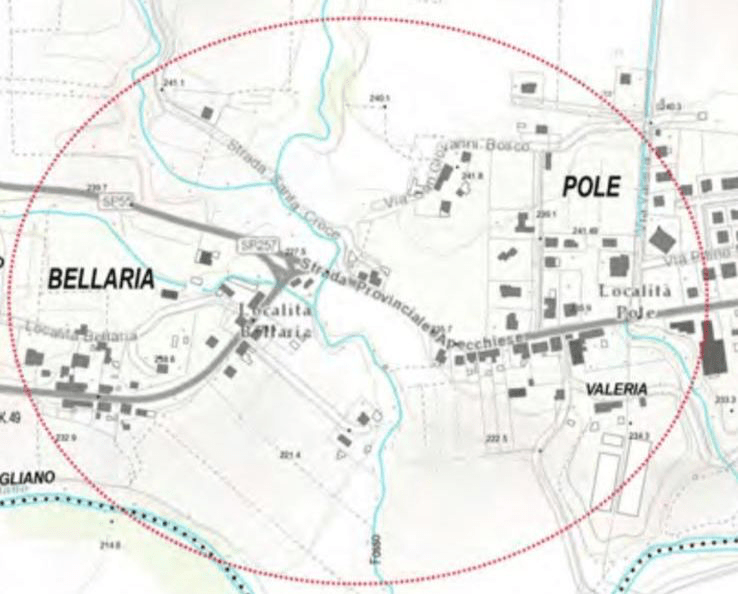
The discovery of an inscriprion of the order of the decurions and of the urban plebs led in 1933 historian Gottardo Buroni to locate it 3.5 km west of Acqualagna, in the area between Le Pole, Valeria and Bellaria, on the left bank of the Candigliano river, a tributary of the Metauro.
Sporadic discoveries, archaeological excavations and especially traces (cropmarks) visible in aerial and satellite photos have confirmed the location and allowed archaeologists like Oscar Mei from Urbino University to trace an hypothetical map of the municipium.


The original extension of the Roman city is not known exactly and it is not excluded that the settlement could have expanded beyond the river in a south-west direction.
The site is located on an alluvial terrace gently sloping towards the river, in an area located at altitudes between 220 and 240 m above sea level.
The highest part of the ancient settlement corresponds to Le Pole (you can park in front of the old train station no longer in use since the Second World War bombings) while the part near the riverbed, known by the toponym of Calpiano, is located on the plain and is bordered to the south by the Calandiano river.

The city was located in a strategic point along a branch of the Via Flaminia that branched off from the main route and continued towards the Apennine pass of Bocca Serriola, which connected the Metauro valley with the upper Tiber valley.The settlement was therefore at the meeting point between two roads that connected the internal Apennine centres with the Via Flaminia.
Our Tabernae – Where to Eat

HOTEL E RISTORANTE LA GINESTRA FURLO – Typical local cuisine, truffles and other delicious plates
Via Furlo, 15-17, Pasdo del Furlo +390721797033
PIZZERIA IL GUFETTO – All kind of pizza with three different doughs.
Via Flaminia, 187 – Acqualagna
+3907211695499
DON’T MISS.. THE DOMUS OF MYTH AT SANT’ANGELO IN VADO At an half an hour drive (27km.) from Acqualagna, you can visit another little Roman jewel: the Domus of Myth at Sant’Angelo in Vado with its breath-taking mosaics. It was discovered at the end of the 1990s. The noble residence was built in the 1st century AD.
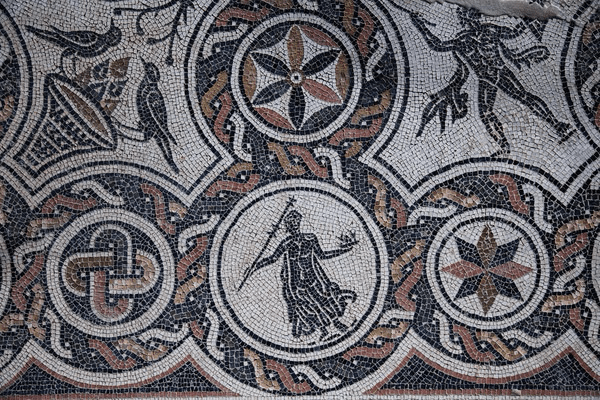
The mosaic floors feature figures and scenes from classical mythology that give the name of the Domus. In the vestibule there is a wonderful representation of Neptune with the trident in his hand who, accompanied by his wife Amphitrite, launches the hippocampi that pull his chariot into a gallop, surrounded by darting dolphins.

In what was probably the house’s tablinum (an open living room on one side of the atrium that could be curtained off from public view), the bust of Dionysus, whose head is encircled by a crown of vine leaves, appears in a central tondo framed by a halo of perspective motifs.

In another of the rooms into which the 1,000 square meters of the Domus are divided, the head of Medusa, bristling with snakes, stands out among a complex network of geometric decorations.
In the largest room, perhaps the triclinium, the room where lunch was served, hunting scenes and the depiction of a fight between marine animals beautifully embellish the space.

It is here that the portrait of a male figure holds in his hand the excellence of this territory: the truffle. The abundant presence of this prized product of the earth has earned Sant’Angelo in Vado the nickname of “land blessed by the Gods”.
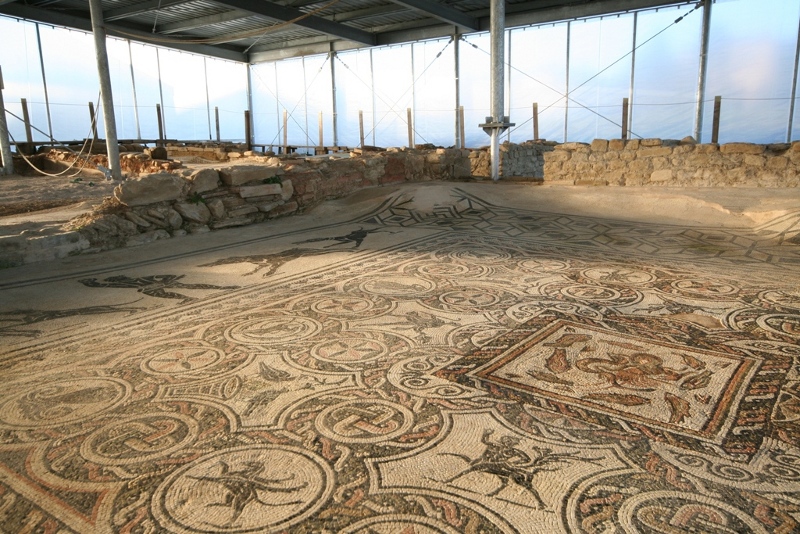
The Domus del mito is located in via delle Ghibelline. It is open from Tuesday to Sunday: 9:30-12:30 and 15:30-18 Monday closed. The ticket is 3 euros (free entry for children up to 6 years old). The ticket office is at the Tourist Office in Piazza Umberto I. If you want to book a guided tour:
+393479782936
info@domusdelmito.it
SINCE YOU ARE IN THE AREA… – Visit Fano, the Fanum Fortunae on the Adriatic Coast that is part of Our Gems with its rich Roman Legacy and the mystery of the Vitruvius Basilica…it is only an half an hour drive!
ACKNOLEDGMENTS – Thanks to Comune of Acqualagna, Pro Loco of Fermignano and archeologist Oscar Mei from the University of Urbino for their precious help.

 Italy as the Romans did
Leave a reply to ROMAN FANO Fanum Fortunae – Italy as the Romans did Cancel reply