- The ’Must see’ – Vitruvius Basilica, the Dream of an Architect
- History and Roman Legacy
- Ancient Rome Itinerary
- Fun fact – A Roman ‘festival’
- Useful informations for Fano
- Our Tabernae, where to eat
- Since you are in the area
The ’Must see’ – Vitruvius Basilica, the Dream of an Architect

Fano, on the Adriatic Sea, is famous for its beaches, sandy or with smooth pebble, but it has also an incredibly rich Roman past. For this visit we must start by talking about a giant of architecture who was almost certainly born in Fano. Marcus Vitruvius Pollio (75 BC – 15 AD), best known as Vitruvius, was a military engineer and architect who wrote De Architectura, the mother of all architectural handbooks that he dedicated to his Emperor, Augustus.

His ideal building must have the three virtues of commodity, firmness and delight: utilitas (it should be functional), firmitas (solid) and venustas (beautiful). In his search of these virtues he looked to nature and the human body. With his ideas he inspired great artists and architects, from Leonardo da Vinci to Andrea Palladio with his Four Books of Architecture.
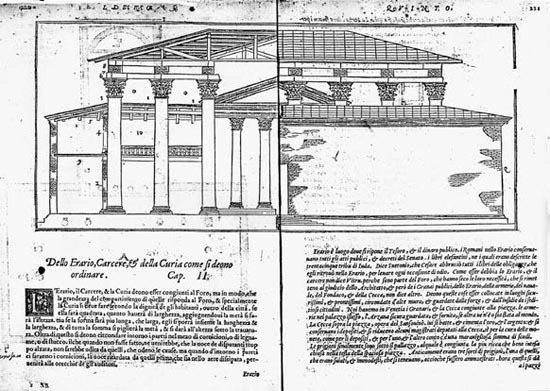
There is only one building of which Vitruvius claims to have supervised the construction (“conlocavi curavique“), to which he attributes values of great dignity and beauty (“summam dignitatem et venustate”): it is the Basilica of Fano, the city called Fanum Fortunae and then Julia Fanensis colony, that is mentioned in five paragraphs of the treatise on architecture (Vitr. De Arch., V, 6-10).
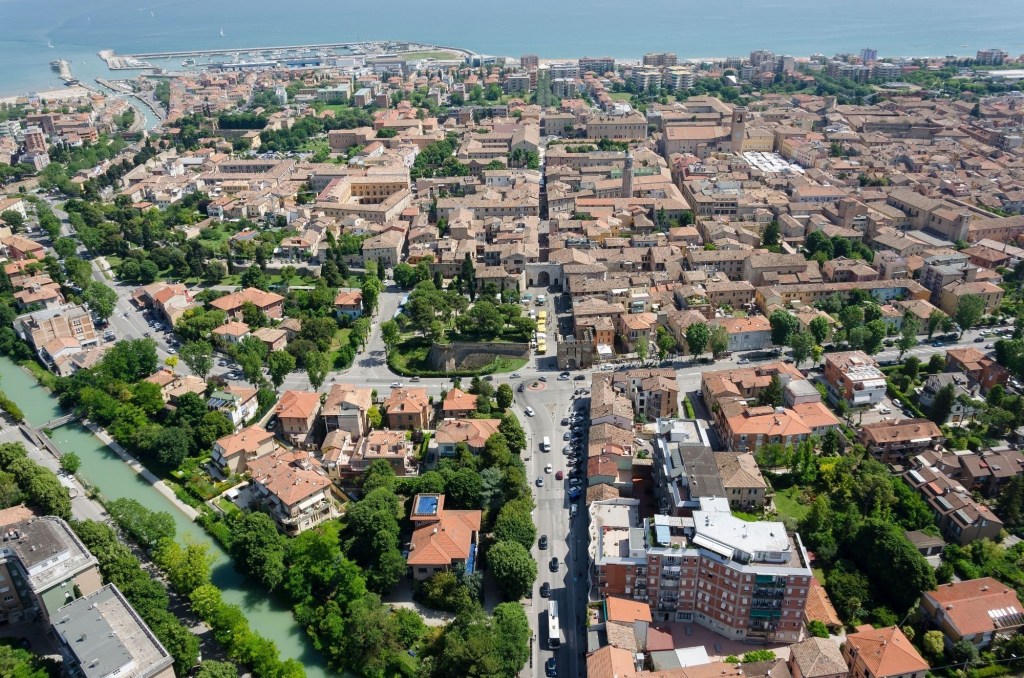
Fano itself, built where the Flaminia road meets the sea, has one of the best preserved Roman legacies in Central Italy, outside of Rome. Under Augustus, it is thought that Vitruvius transformed this colonia into a soft of ‘Ideal city’, with new buildings that respected ghost architectural canons.
The exact location (or even the existence) of Vitruvius Basilica had always been a mystery, so this ‘Must see’ was meant to pay tribute to a universal idea, more than just a visit. But on the 19th of January 2026, a sensational announcement changed everything: archaeologists have finally discovered the remains of this ‘Holy Graal’ of Roman Architecture, after five centuries of researches and hypothesis.
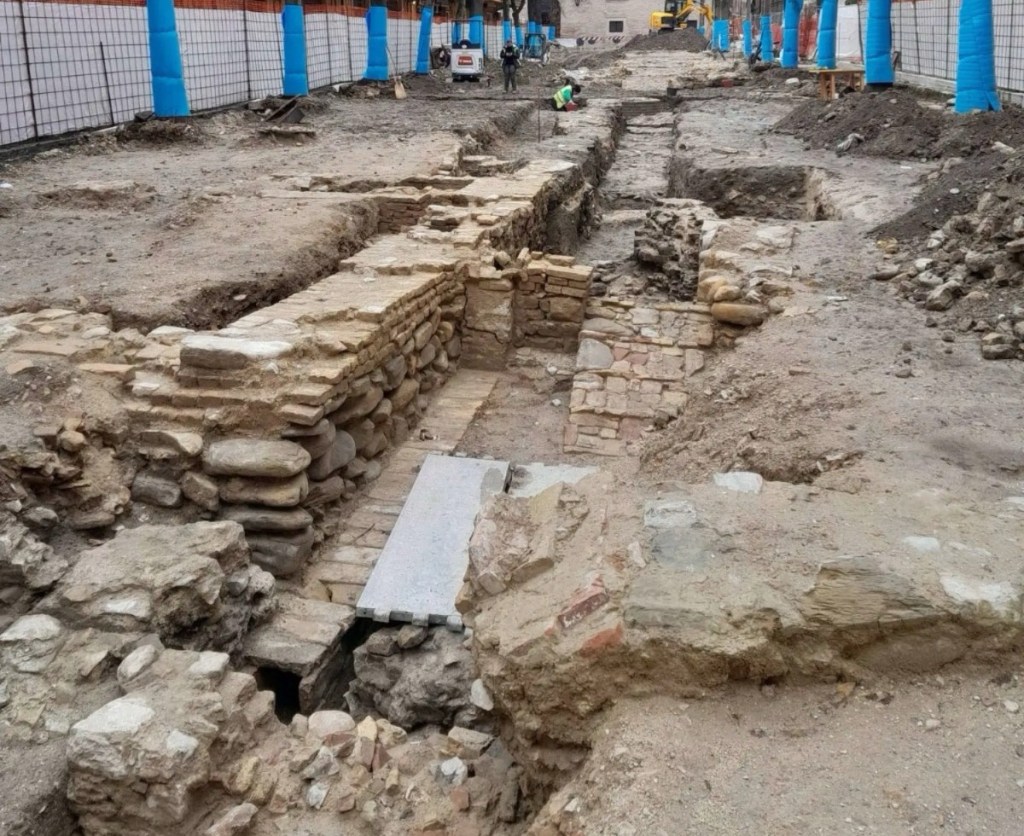
An absolute match to columns and foundations of the Basilica was found under Piazza Andrea Costa, south-east of the Roman Forum, during excavations for requalification works in the area.
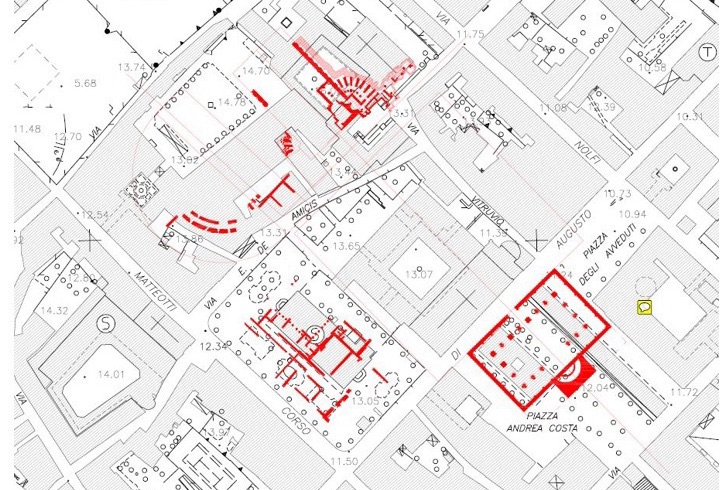
A total of five imposing columns, 15 meters tall and resting on supporting pillars have been uncovered, exactly as noted by Vitruvius. Overall, the entire planimetric reconstruction agrees to the centimeter with that described in De Architectura. Studies and field research conducted in recent years by the Superintendency of Archaeology of Ancona and Pesaro-Urbino, in collaboration with local and national institutions, have led to the definitive recognition of one of the most important buildings in the history of architecture.
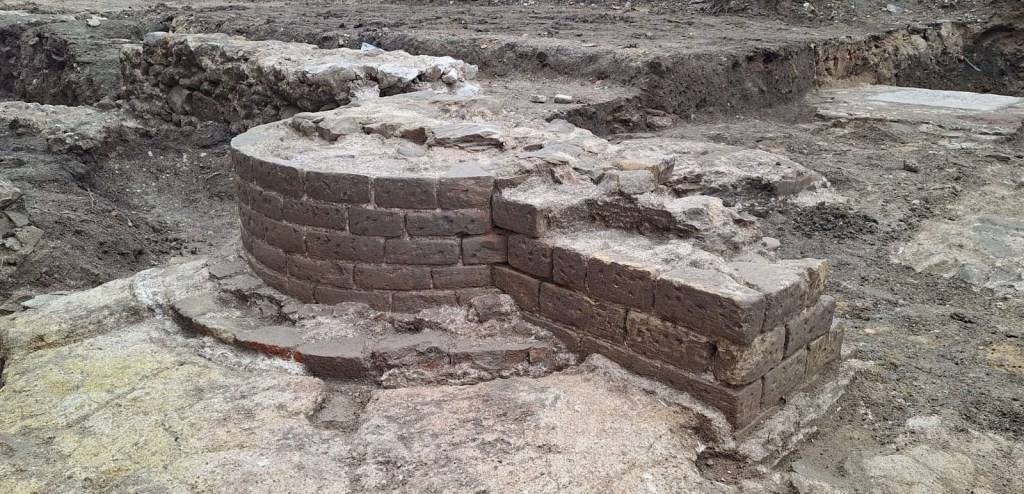
The basilica had a rectangular layout, with 10 columns on the long side, and four on the short ones. When traces of four columns emerged during excavations, archaeologists used Vitruvius’ descriptions to calculate where the top right corner column should be.
When they started digging, they found it immediately: the mystery has been solved. Archaeologists are already considering how best to protect and present what is left of the Basilica to the public, recognizing the long-term cultural value of unveiling a structure that bridges written ancient knowledge and physical history.
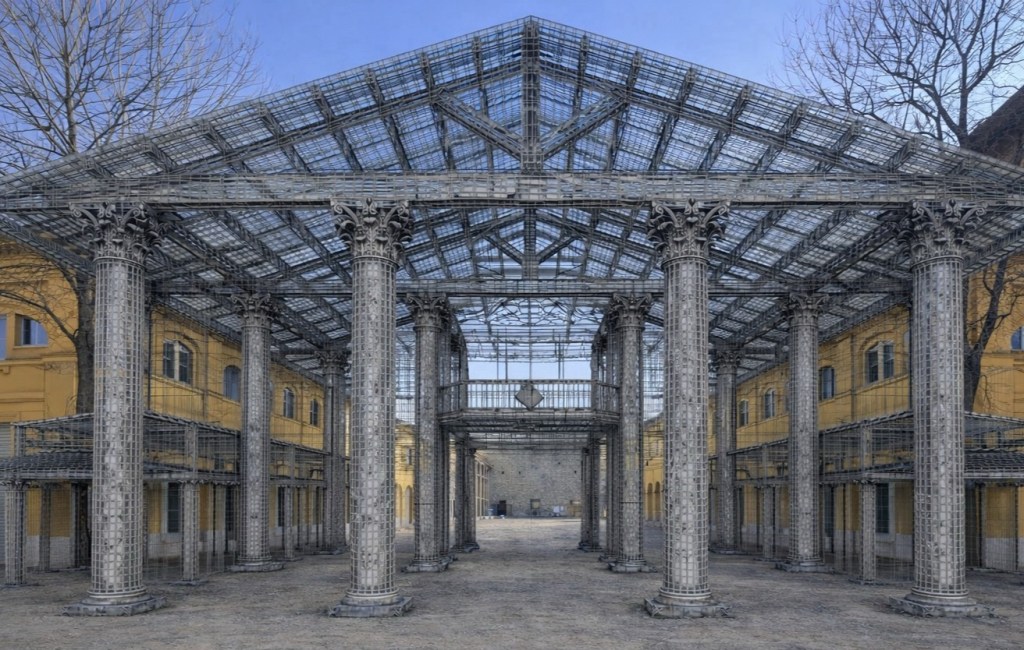
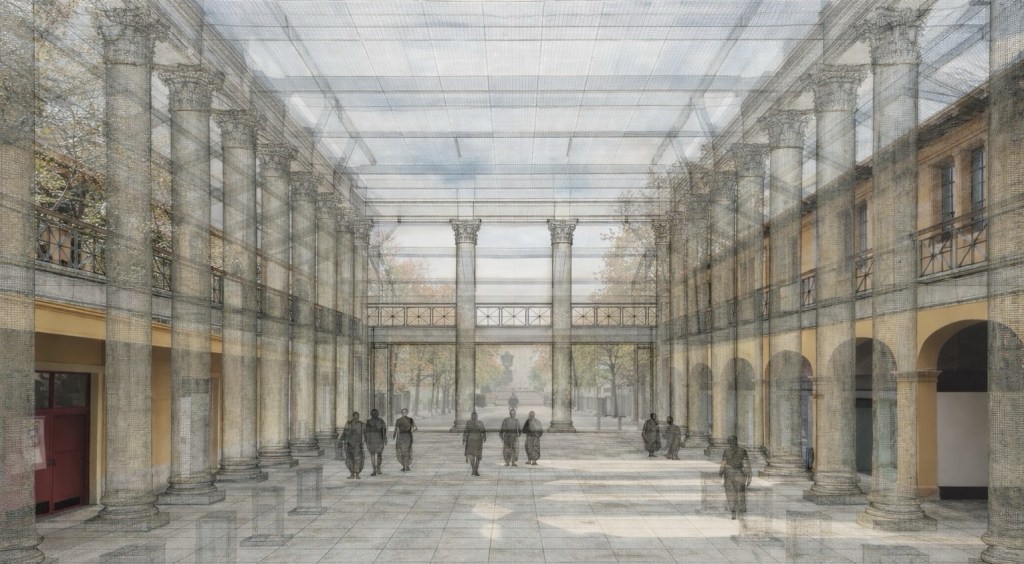
Now we have to wait until these remains will be visibile but Fano, a sort of Roman ‘Ideal City’ conceived under Augustus at the direction of Vitruvius, is now more than ever on the world Archaeological map!
THE PREVIOUS HYPOTHESIS AND OTHER ROMAN RUINS – In 1840 during excavations under the Church of St. Augustine, in Fano, ancient roman ruins emerged. A careful survey campaign in the nineties had shown metric consistencies between the measurements of the Basilica described by Vitruvius and those of the archaeological remains.

About two meters below the current street level, a large external perimeter wall thirty meters long and four meters high is preserved, divided into pillars and windows, a radial structure composed of quadrangular pillars linked, via small arches in a fan shape, to trapezoidal walls and a large exedra flanked by a vaulted portico.

 )
)The building technique for the walls is extremely careful and homogeneous: a lot of masonry with the interior of cement mortar and outer blocks of yellow sandstone extracted from local quarries.

Towards the north-east side of the complex are visible structures of functional character identifiable in a small bathroom.

The cryptoporticus had the function of supporting the upper floors, but also that of a covering for the functions practiced in the building and this is why identification with the civil Basilica created by Vitruvius had been hypothesized. Basilica is a word of Greek origin (‘basilike’ means palace) to define a rectangular building with a central nave flanked by 2 or 4 smaller, lower naves, divided by columns or pillars, which opened onto the city forum. In Ancient Rome it was was the center of meetings, business and often it hosted the court of justice.
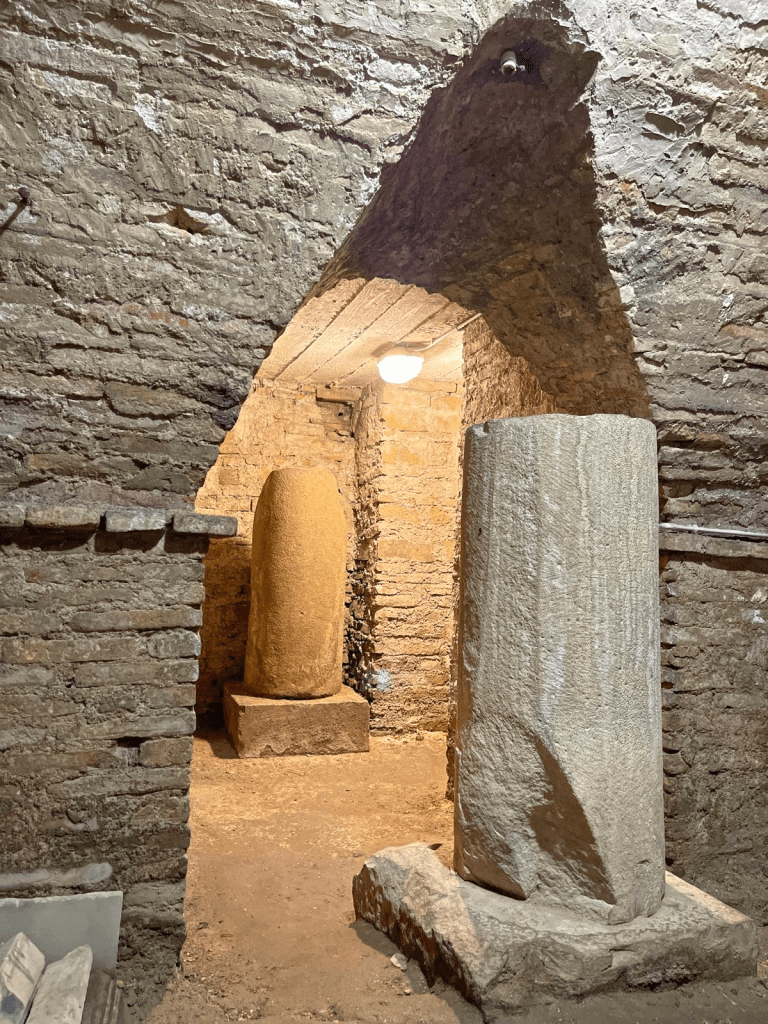
The epigraphic documentation shows building activity beneath the Church and Convent of St. Augustine, overall, from the 1st century BC. to the 3rd-4th century AD. Another hypothesis, now the mist credible, is that the remains were part of the Temple of Fanum Fortunae that gave the city its name.

In March 2023 a discovery was made that at first had been linked to the Vitruvius Basilica: the remains of a large, luxurious Roman public building were unearthed just opposite the ancient city’s forum, during works of renovation of private apartments.
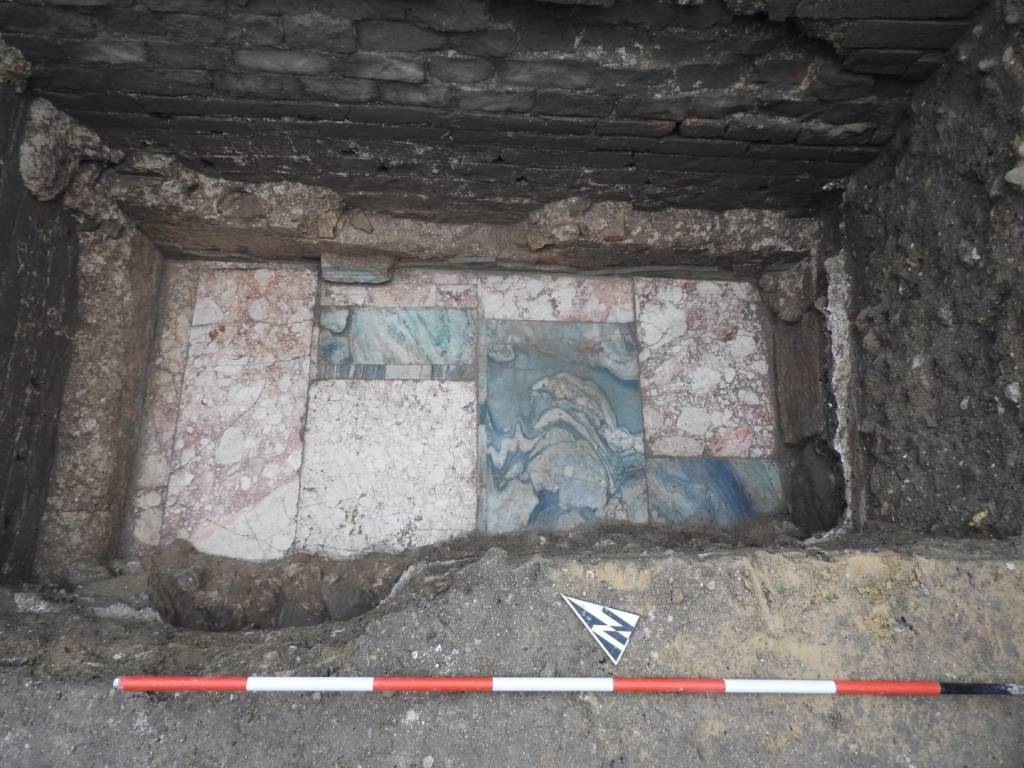
What has been found are the ruins of at least five rooms with floors adorned with large slabs of marble in green and pink. The walls, five feet thick and coated in lime mortar, have been preserved up to a height of more than six feet. Marble slabs decorate the sides.
The building dates back to around 2,000 years ago. A clue is offered by a fragment of an inscription with two letters of its original rubrication that are still visible because the red pigment rubbed into the letters to make them stand out against the marble: they are a V on one line and an I on the line below it.
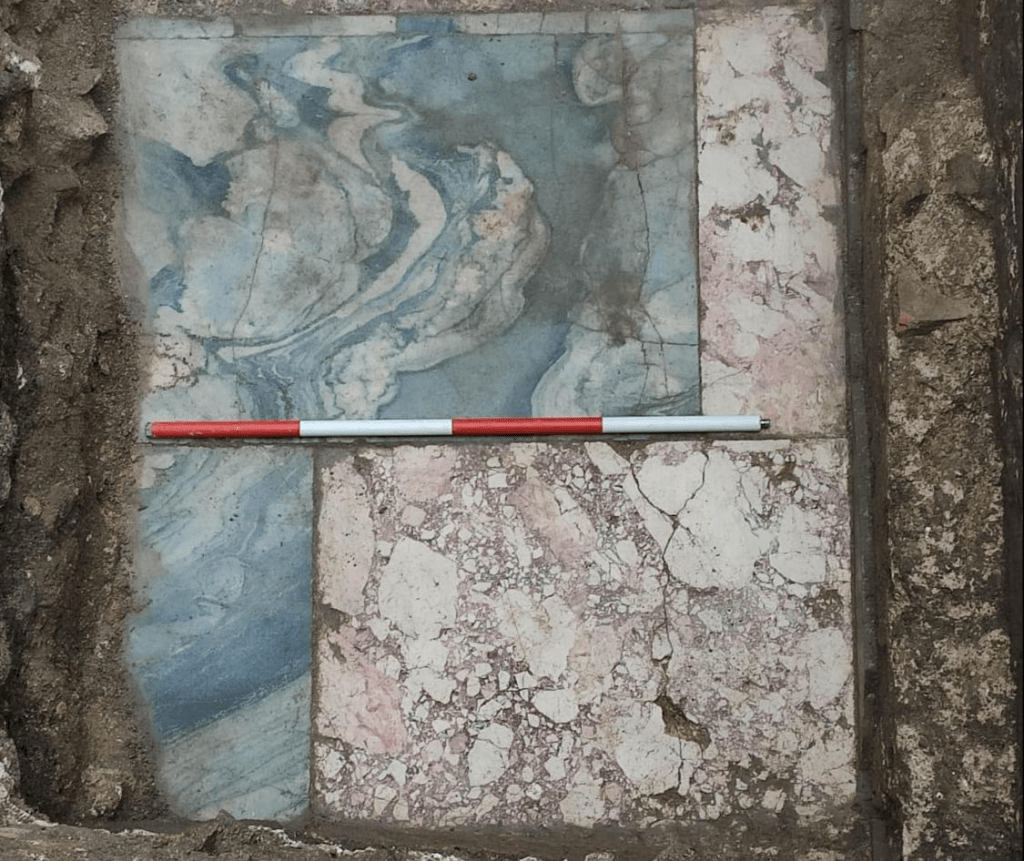
The location across the site of the ancient forum, the scale of construction and the richness of the marble inlays of the floor and walls mark it as a major Roman public building of the Augustan era (1st c. B.C. – 1st. c. A.D.) This is why it was thought it could be part of the much-sought Basilica of Vitruvius.

Particularly suggestive is a single fragment of a giant column (diameter 1.475 m, the five feet of the Vitruvian column) made of stone blocks similar to those of all the surrounding wall structures and that fits well with the description of the Vitruvian text.

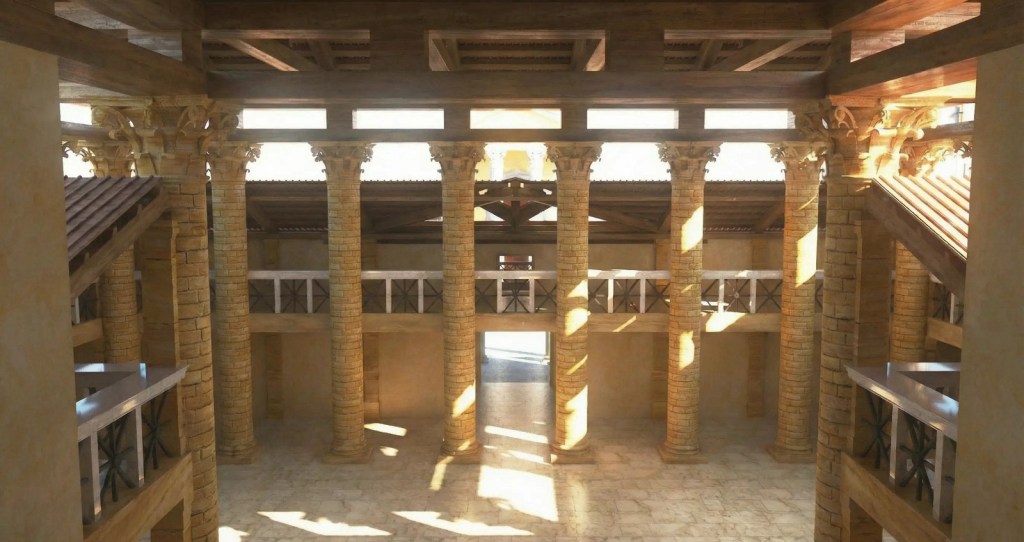
Now that we have an exact location of the Basilica under Piazza Andrea Costa, we can imagine how it was through an extremely detailed three-dimensional model of the Basilica, using Autocad and 3DS, has been created based on Vitruvius treatise.

The basilica, according to it, faced the center of the Forum with one long side and was aligned with the facing Temple of Jupiter on the other side of the square. The use of large columns which alone “covered” the two floors of the basilica increased the sense of “magnificentia” and “auctoritas”. The Corinthian columns are 50 Roman feet tall (about 47ft, 14.5m) with a base diameter of 5 Roman ft, a little larger than those in the portico of the Pantheon. To give an idea, the columns in the portico of St Paul’s in London are 40ft tall.

Vitruvius enduring legacy has lasted through the centuries, for 2000 years: Leonardo da Vinci was influenced by his proportional theories for the drawing of the Vitruvian Man, an icon of Renaissance.

The basilica that Vitruvius built in the Colonia Iulia Fanestris, one of the best-known monuments of antiquity, has finally been located. It is assumed that it may have been destroyed by an earthquake in the 3rd century AD or in 538 AD by the Ostrogoths of Vitiges who besieged and devastated the city and could have targeted one of the symbols of the greatness of Rome. The myth of the Basilica, though, now more than ever, is still definitely standing in Fano.
History and Roman Legacy
Fanum Fortunae owes its name to the goddess Fortuna (the personification of luck in Roman religion) and the temple dedicated to her, erected to commemorate the battle of the Metaurus River in 207 , during the Second Punic War, in which the Roman legions defeated the Carthaginian army led by Hasdrubal Barca.

The latin word fanum means ‘shrine’ and it was precisely around the ‘Temple of Fate’ that the first settlement sprang up between the second and first century BC. It was a small village on the terrace just north of the mouth of the Metauro river, a “Conciliabulum Civium Romanorum”, a meeting place of Roman citizens. It was situated in a strategic position that provided an outlet to the sea of Via Flaminia (built in 220 BC), and that led to Pesaro and Rimini further north.

Julius Caesar refers to Fanum in his “Bellum Civile” explaining that after the passage of the Rubicon River, in 49 BC, he sent his general Mark Anthony to occupy “Pesaro, Fano and Ancona with a single cohort by city”.
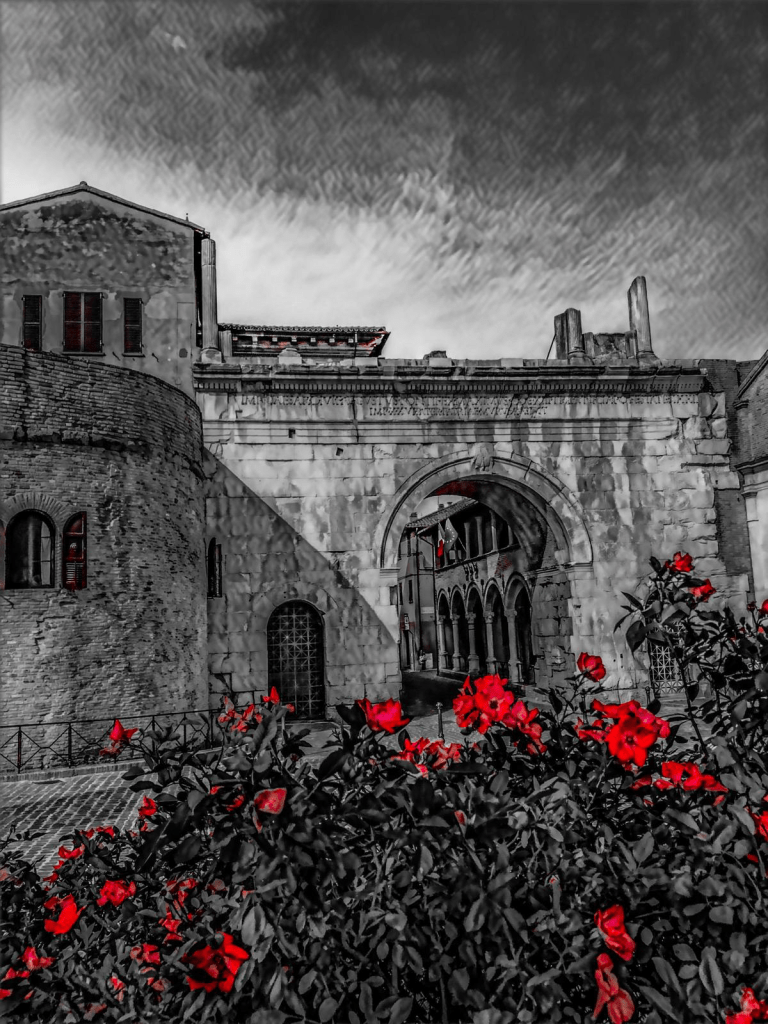
Fano was completely rebuilt by Augustus who between 31 and 27 BC fortified it with mighty walls, developed it as a Roman colony around the axis cardo and decumanus, and gave it the name of Colonia Julia Fanestris.
The colony was included in the VI regio of the Augustan division.
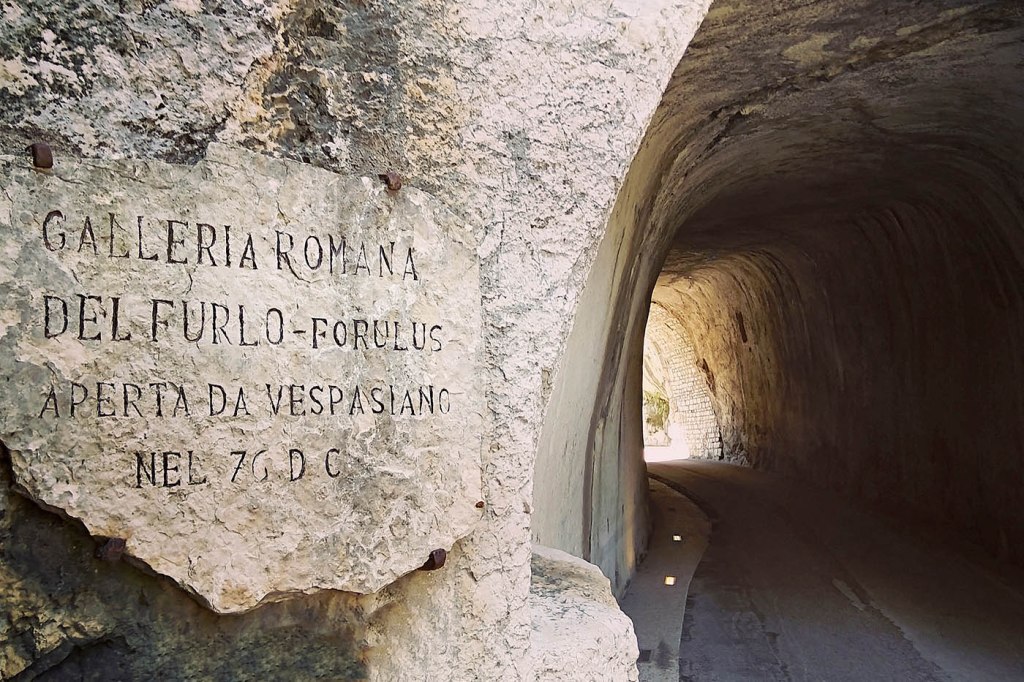
In 76 AD Emperor Vespasianus opened a tunnel between the mountains near Fano: it was called Furlo (from forulum, little hole). See Furlo and Acqualagna in our LITTLE JEWELS section
In 271 AD the Battle of Fano or of Fanum Fortunae was fought in the area between the Romans, led by Emperor Aurelian, and the Germanic tribe of the Juthungi (they came from today Bavaria) that prevented an invasion of Rome. Aurelian managed to force a battle on the Metaurus River, just inland of Fano, and his legions pinned the Barbarians against the Metaurus, so that, when the Germanic line was forced to give way, many of the Juthungi fell into the river and drowned.
In 538 AD Fano was besieged and devastated by the Ostrogoths of Vitiges and shortly after rebuilt by the Byzantine army of Belisarius and Narses.
Ancient Rome Itinerary
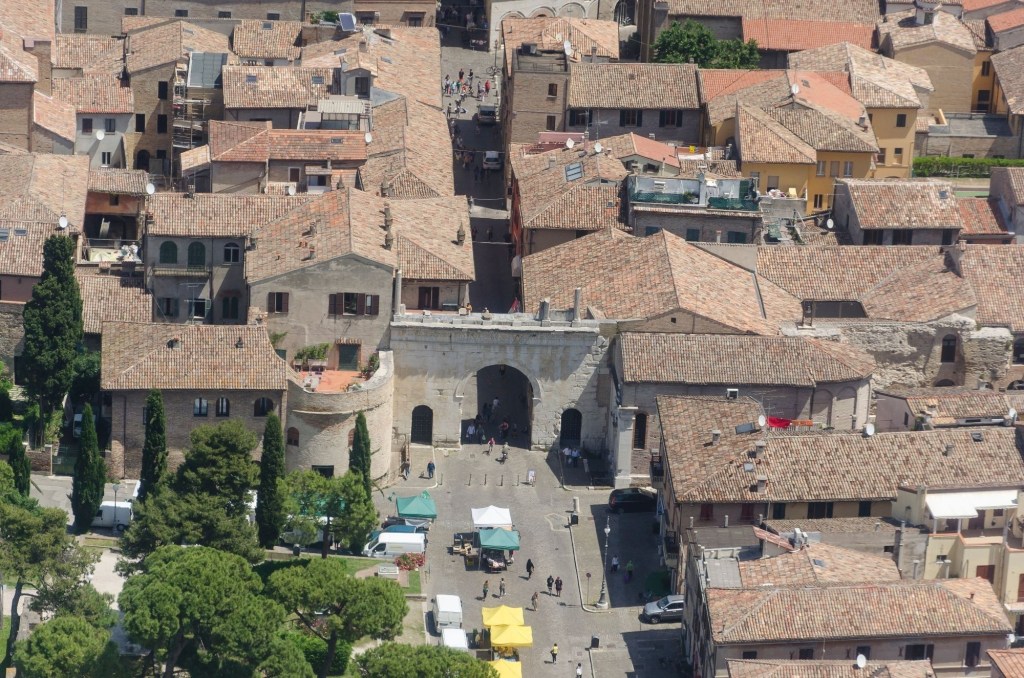
A visit to Roman Fano can only begin at the Augustus Arch. Always a symbol of the city of Fano, it wasn’t a honorary arch but the main gateway to the Colonia Julia Fanestris, dedicated by Rome first Emperor, Octavian Augustus, on the site of a settlement developed around the republican Fanum Fortunae (temple dedicated to the Goddess Fortuna). The inscription (originally with letters in gilded bronze) reads: “The emperor Caesar Augustus, son of the Divine (Julius Caesar), pontiff maximus, consul for the thirteenth time, (covered) with tribunician power for the thirty-second time, acclaimed emperor for the twenty-sixth time, father of the country offered the walls”.

Built at the point where the Via Flaminia joins the city’s Decumanus Maximus, the monument is dated, through the frieze inscription, to 9 AD. It is built externally in squared blocks of limestone from quarries on Mount Nero.

The arch was topped by a Corinthian pseudo-portico attic, with seven arched windows separated by eight semi-columns, that was almost completely destroyed by Federico da Montefeltro during the siege of 1463. The stones from the attic were reused in the construction of the adjacent church of San Michele. The gateway is divided into two minor side fornixes and a major central fornix that was decorated with a representation of an animal that is no longer recognizable.

Museum of the Via Flaminia – Housed in the church of San Michele, it does not display artefacts, but only original digital content on the archaeological heritage of the city of Fano and the territory of the ancient Via Flaminia. The Museum is divided into two rooms and it offers a virtual and immersive journey to discover the history of the ancient consular route, through videos, video interviews, multimedia installations and augmented reality apps.
Augustus statue – On the area in front of the arch called Pincius (from Mons Pincius, the panoramic hill in Villa Borghese, in Rome) there is a replica of a statue of Gaius Julius Caesar Augustus donated to the city by Benito Mussolini and inaugurated in 1937.

Augustan Walls – Continuing our journey northward we encounter the Augustan Walls. Intended by Emperor Augustus in the grandiose project of monumentalizing the city and completed in 9 AD, the walls are still preserved today for about two-thirds of the original circuit.They are in Opus Vittatum, with rectangular sandstone brick blocks very similar to modern solid bricks.

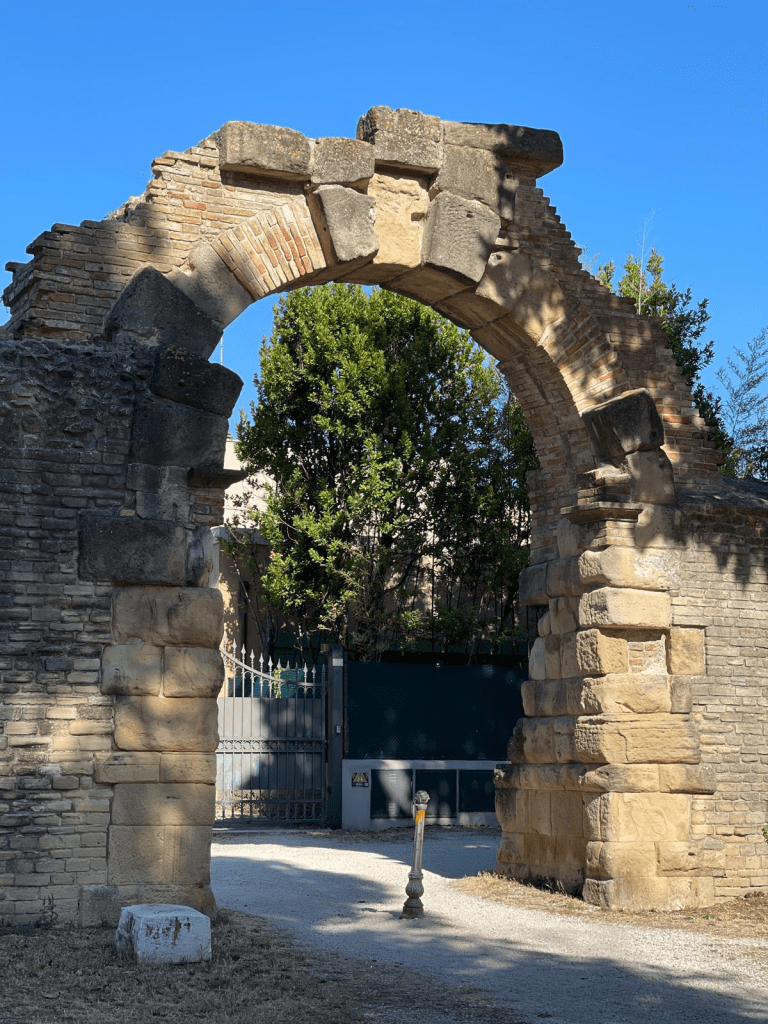
The curtain wall, which was rescued from demolition in the 1920s, is made of sandstone ashlars in horizontal rows with an inner filling of mortar and working flake. Along the walls there are cylindrical towers. In addition to the well-known Porta d’Augusto, a secondary gate called the Porta della Mandria (Gate of the Herd) is inserted into the walls, useful for the flow of traffic exiting the walls to the north.
The Augusteum – Another gem of Fano is the Augusteum, a temple from the end of I century BC: its ruins are beneath the Mediateca Montanari, in Piazza Pier Maria Amiani.

They were discovered in 1899, during the demolition of the monastery of the nuns of San Filippo. The excavation campaigns brought to light a large area surrounded by a quadriporticus with brick columns, plastered and painted red in the lower part, with Tuscan capitals in gray limestone.

On the eastern side of the Portico an imposing building was assigned to the imperial veneration of Emperor Claudius, who reigned from 41 to 54 AD.
It was a wide room sumptuously composed by polychromatic marbles on the floor and on the walls, and by arcade or opposite pronaos, perhaps having four Corinthian columns that faced the Decumanus Maximus, which corresponds to the current street of the Arch of Augustus. Statues of Claudius, of his second son Britannicus and other imperial family members composed the images of this veneration strongly diffused in the whole Roman world.

The room created under the atrium is used for conferences and as an archaeological documentation point for school groups and tourists participating in the Fano Romana tour. The columns of the peristyle are also visible while the foundations are displayed through a walkable glass window which allows you to grasp the extension of the temple and the different ways of building.
Roman theatre – In 2001 the remains of a Roman theatre were found within the walls of the city, in an area near Via Arco d’Augusto at South East and Via XXIV Maggio at North West.
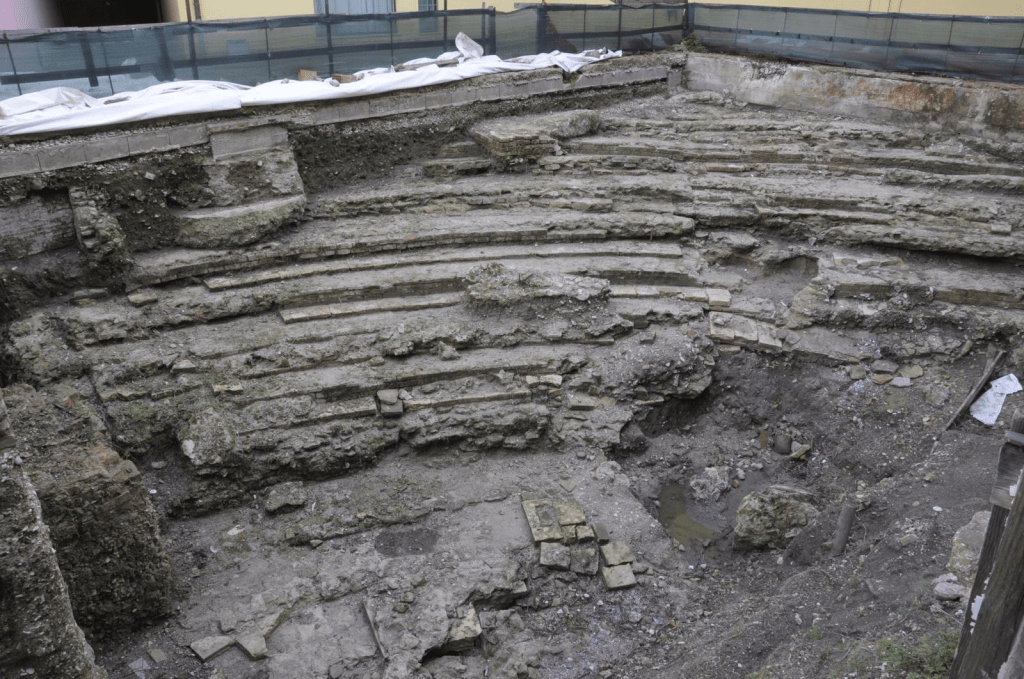
It is not visible at the moment but what has emerged are two sectors adjacent to the first cavea (the lower part of the steps), portions of the floor level of the orchestra (central enclosure in which the choir performed) with part of the proedria (the first row of seats) and a probable access to the theatre (the aditus), as well as a series of parallel wall structures referable to the proscaenium (proscenium), the pulpitum (stage) and the frons scenae (permanent architectural backdrop) and the valva regia (the central door of the scene).
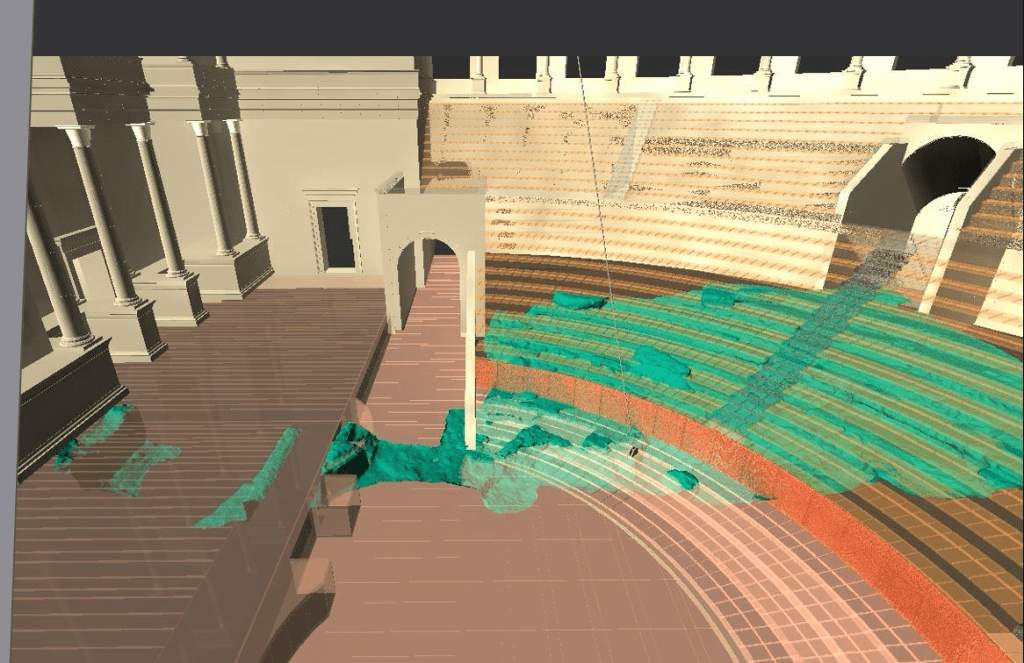
The steps, originally at least thirty, of which today only eight survive, were approximately between 30 and 35 cm high and between 73 and 75 cm deep and were built in opus tertizia di sesquipedali (bricks with a side of foot and a half, corresponding to just under 45 cm.).

The frons scaenae reached at least 10 meters in height, maybe up to 14 metres, while the cavea could also rise above this height, if it had been equipped with the summa cavea (the highest part of the steps).

The minimum capacity of the building was 2500-3000 people. Several clues suggest the presence of a complex decorative and architectural structure.
Remains of a Domus – Around 1950 they were found on the southern side of piazza XX Settembre: they belong to an elegant private residence from the Roman.
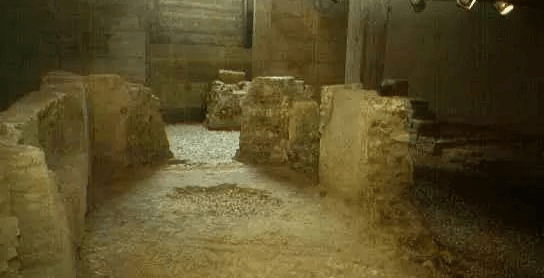
The remains of a room with four columns are easily recognizable, suggesting the presence of an impluvium (the rainwater collection tank). For Guided Tours you can go to www.turismofano.com (official website of the Municipality of Fano Tourism).
City Museum, archaeological section – Set up on the ground floor of the Palazzo Malatestiano, the Archaeological Section houses artifacts from various periods found in Fano and its territory as far back as past centuries.

The so-called panther mosaic (datable to the mid-2nd century A.D.) has also been vreassembled under the 15th-century portico of the Corte Malatestiana.

Inside there are Roman artifacts (ampullae, lachrymates, a collection of oil lamps, fragments of glass, votive terracottas, idols, brooches, rings and more) of various and not always documented provenance. Particularly noteworthy is the famous Graccan cippus that testifies to the implementation in the Fanese territory of the Lex Sempronia (133 B.C.), a radical agrarian reform that distributed public land to the poor.

There are also a number of stone and marble heads, including a splendid female head with Octavia-style hairdo (late 1st century B.C.), a nice statuette of a young man with toga praetexta, bulla and footwear, a large mutilated statue depicting Emperor Claudius, various architectural and sculptural fragments, amphorae, terracotta floor tiles and the central emblem of the so-called Neptune mosaic with the image of the god standing on a quadriga pulled by hippocampi (late 2nd and early 3rd centuries A.D.).

Fun fact – A Roman ‘festival’
Every July, Fano travels back in time to its Ancient Roman times with ‘Fanum Fortunae’, a sort of Roman festival that was previously called ‘Fano dei Cesari’ and that has been reintroduced in 2018, after a 7 years hiatus. Organized by the Municipality of Fano, it is a mix of fun and culture that for four days shakes the quiet Adriatic city with a parade of costumes, spectacular games and a lot of events.

The key words are Ludi, the game, certamina, the competition, declamations, for the cultural aspect, castra for the presence of military and civilian camps, pompa magna, for its magnificence, bacchanalia for parties and banquets.
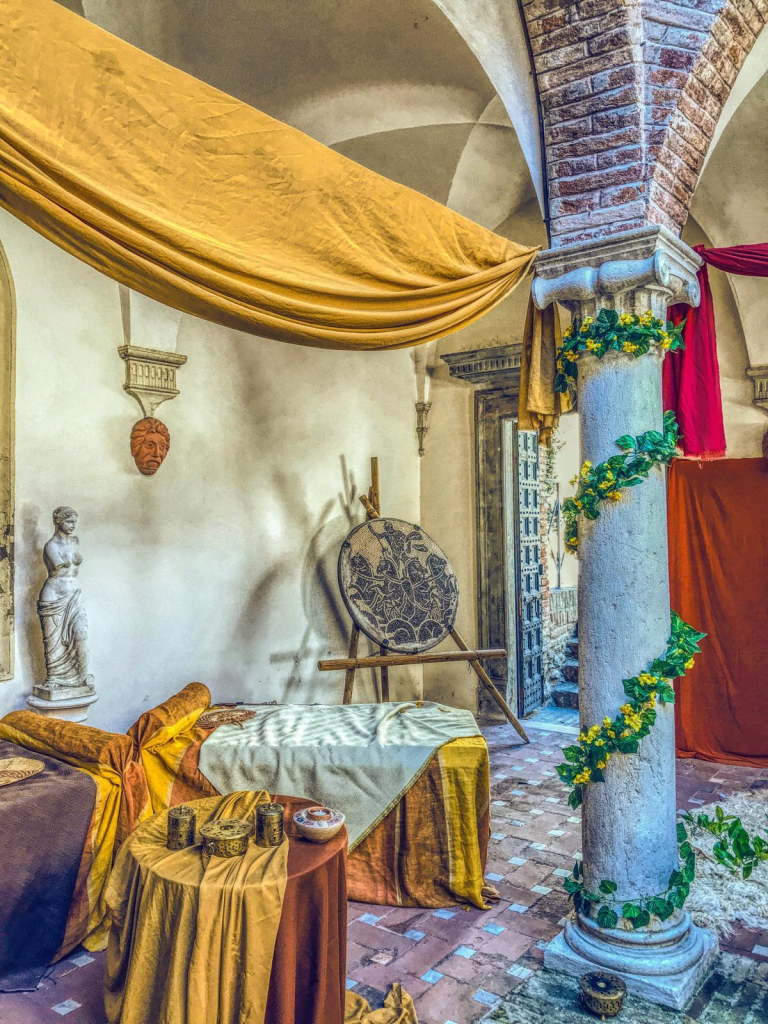
The Festival is opened by the rite of the sacred fire and the lighting of the brazier of the Fanum Fortunae on the Pincius, organized by the Vestali group of the local Colonia Iulia Fanestris.
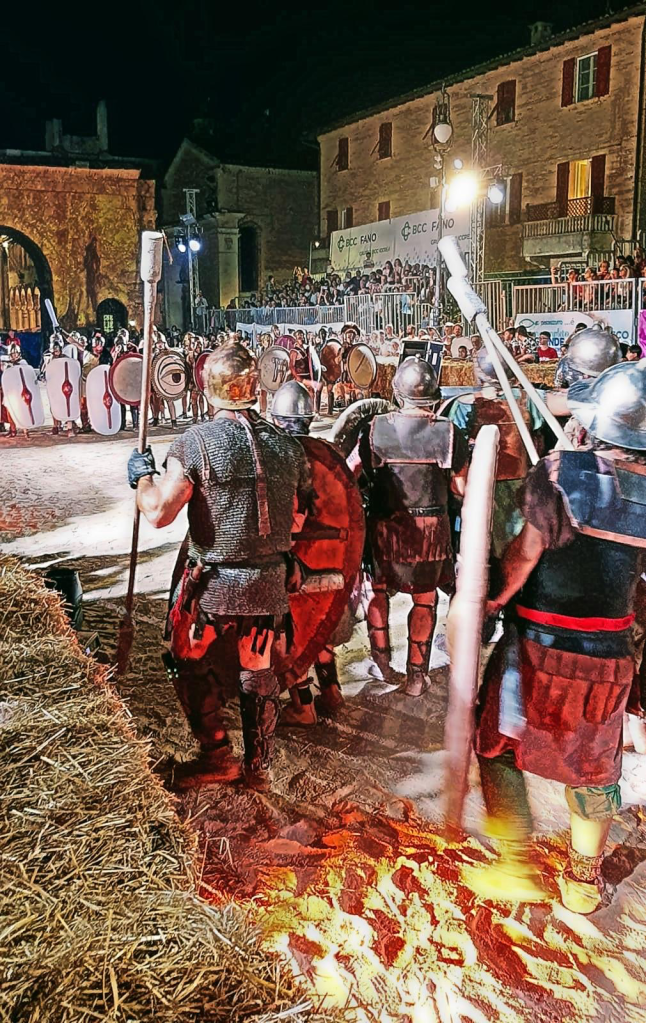
During the Festival there are camps with military reconstructions, archery, artisans and historical games. In the area of San Michele, the reconstructions of an ancient Roman Domus and a Castrum Praetorium host shows with music and dances.
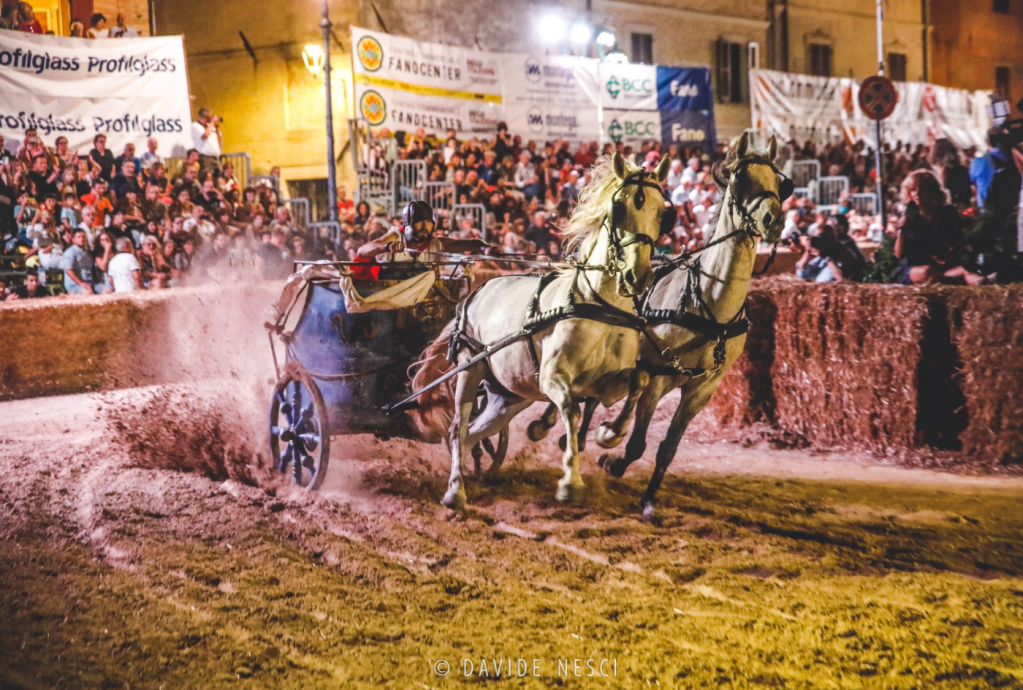
The highlight of the event is the final parade and the chariot race on Sunday. There is a prize for the winning faction of the groups of citizens competing (Boar, Dolphin, Wolf and Fox) but above all it is the occasion for the city to share with its visitors the fascinating Roman roots.
Useful informations for Fano
For information about the archaeological area under the church of St. Augustine contact +39 366 3426985 from 9 am to 11 pm. Groups must e of a maximum of 20 per visit. Cumulative ticket: 10 €
Museo Civico + Museo della Via Flaminia + Area Archeologica S. Agostino. Single ticket Area Archeologica: 4 € (18-26 years old: 3 €) Guided tours by Archeoclub d’Italia are available at this link: https://www.facebook.com/profile.php?id=100068164524950y
Our Tabernae, where to eat
La Taverna del Ghiottone (fish and meat) – Via Roma, 87/B, Fano
Il Cuciniere (Mediterranean cuisine) Via Giordano Bruno, 13, Fano
Since you are in the area
Don’t miss the Roman galleries at the iconic Furlo gorge, the Roman Antiquarium in the ‘capital of truffle’ Acqualagna and the ‘ghost’ of a Roman municipium. See our LITTLE JEWELS section


 Italy as the Romans did
Leave a reply to LITTLE JEWELS Furlo and Acqualagna – Italy as the Romans did Cancel reply