- The ‘Must See’ – Villa Jovis
- History and Roman Legacy
- Roman Itinerary
- Fun Fact – Tiberius, the Emperor who neglected Rome
- Useful Informations for Capri
- Our Tabernae – Where to Eat
The ‘Must See’ – Villa Jovis
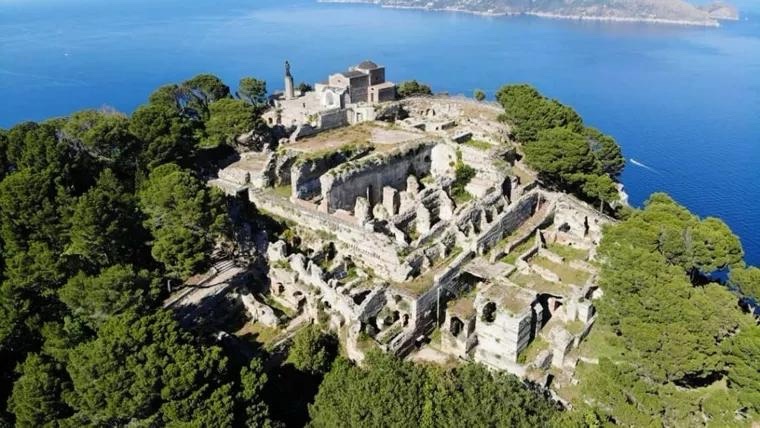
Long before European aristocracy discovered its “impossible” scenic beauty in the 20th century, the island of Capri had been at the heart of the Roman Empire and therefore of the world when Tiberius chose it as its residence, in 27 AD. For eleven years the Emperor successor of Augustus lived in this volcanic gem shining amid the azure waters of the gulf of Naples. From this island he ruled a territory that went from Lusitania (today Portugal) to Armenia, indulging in his own vices.
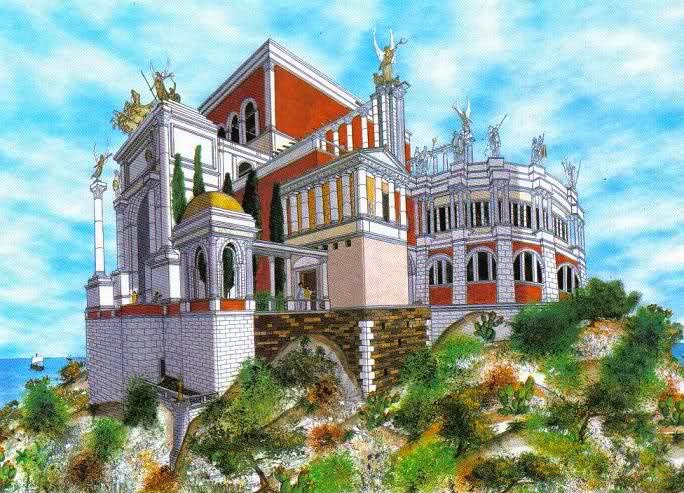
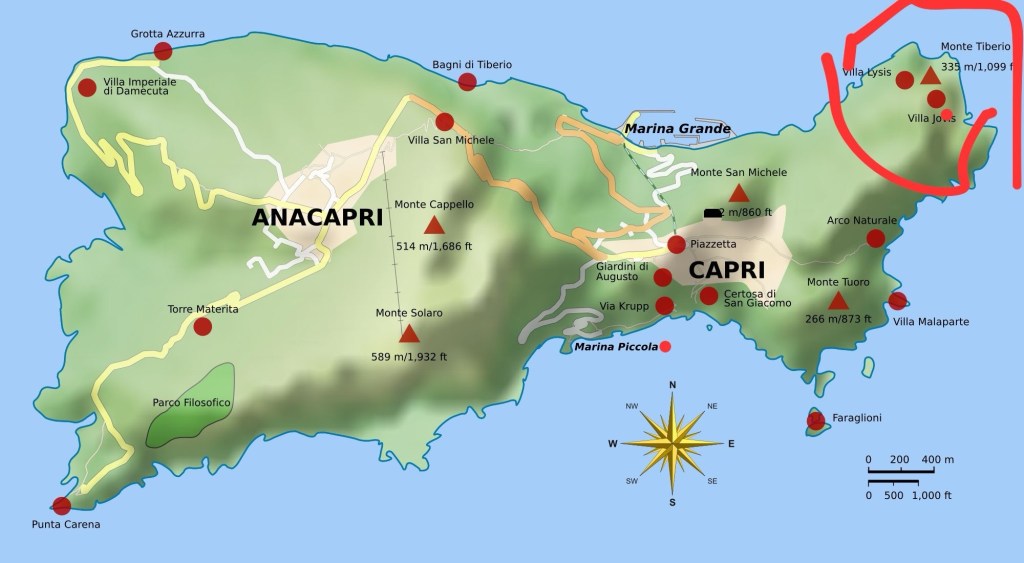
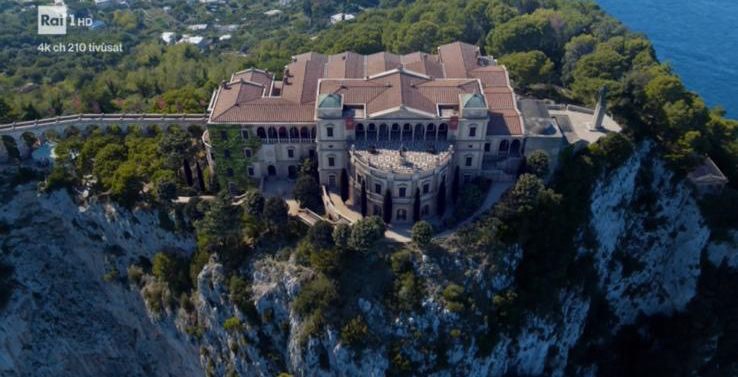
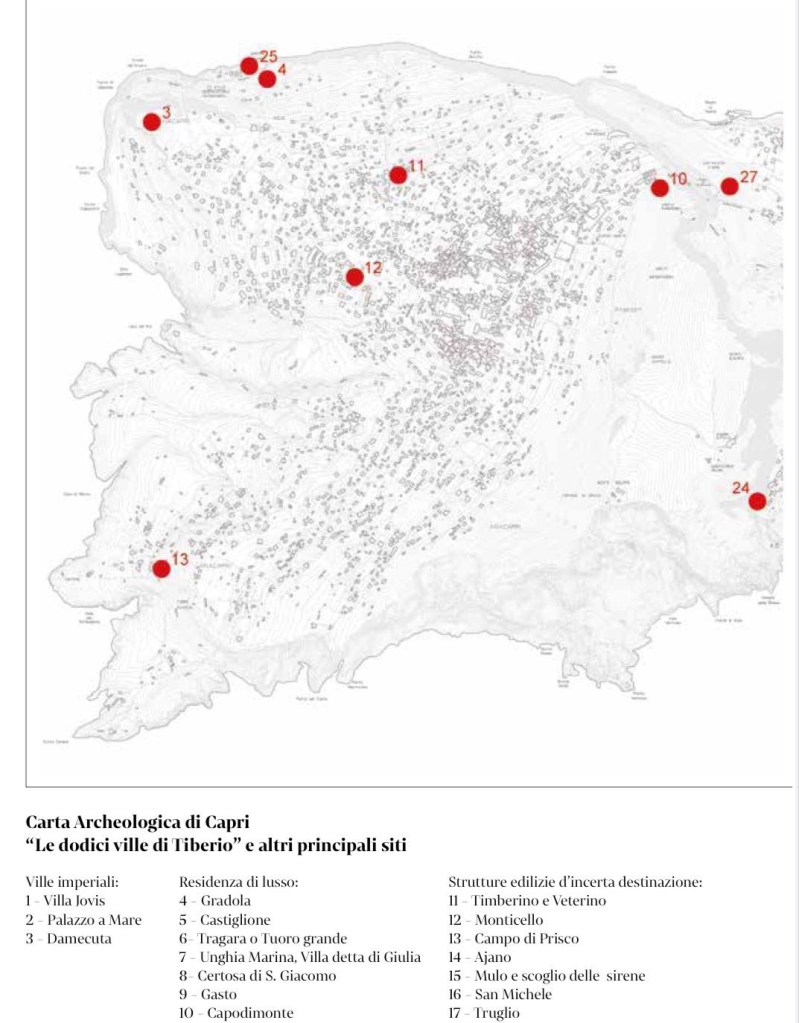
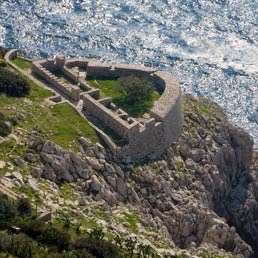
Tiberius commissioned 12 villas to be built on the island: of these Villa Jovis was the largest and most sumptuous, dominating the Mount Tiberius promontory and the slope descending to Cesina.
The view from the north side encompasses most of the Gulf of Naples, stretching from the island of Ischia to Campanella Point, on the Sorrento peninsula.
The position was chosen for its cliff’s edge providing both privacy and security. The location was exceptional, the Romans loved to place their villas halfway up the hill or along the coast, overlooking a valley or mirroring the sea. Tiberius instead wanted for himself the most solitary peak, an abysmal cliff remote from any other inhabited place, and there he built his falcon’s nest. It was a fortress villa, more castle than palace, more hermitage than imperial mansion.
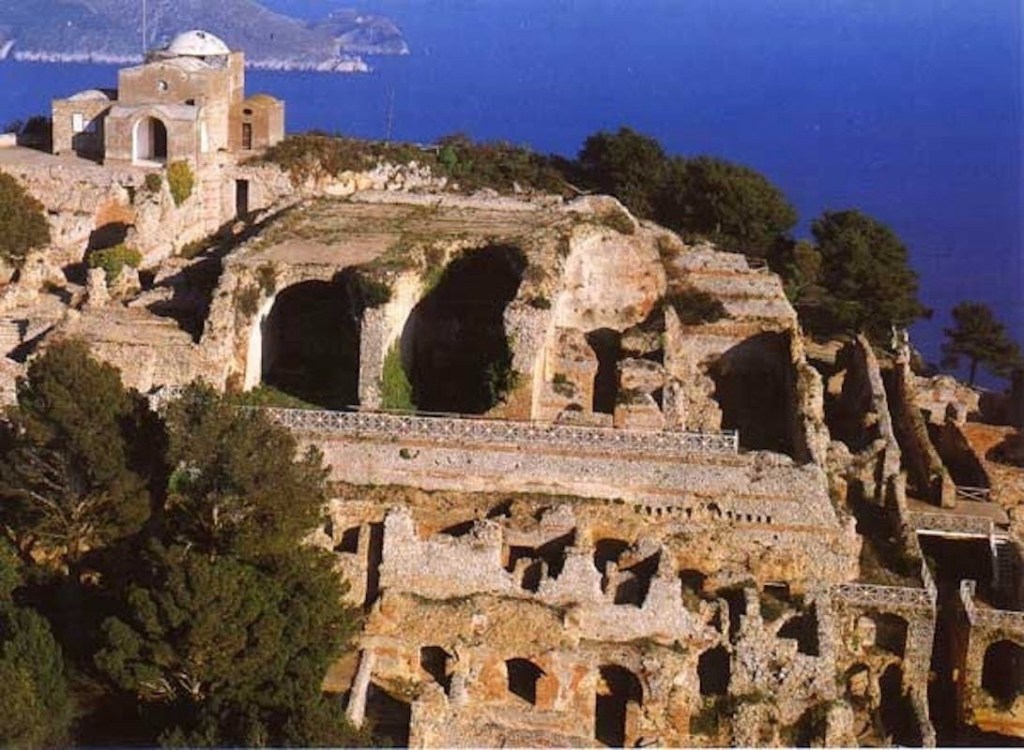
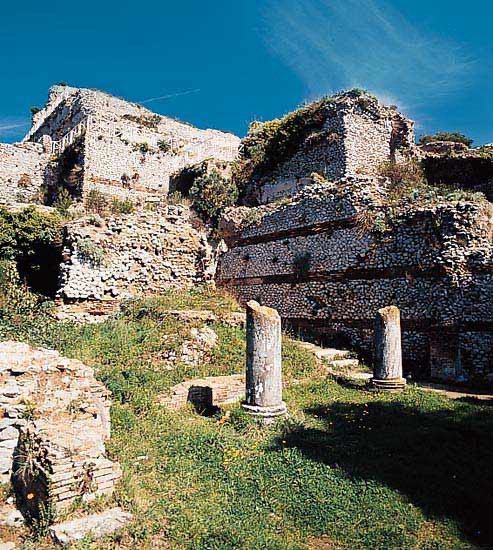
The Villa offered the best of 1st-century AD Roman architecture. Buried and forgotten for centuries, during the reign of Carlo di Borbone, in 19th century, Villa Jovis underwent the first excavations and many precious marble floors were removed.
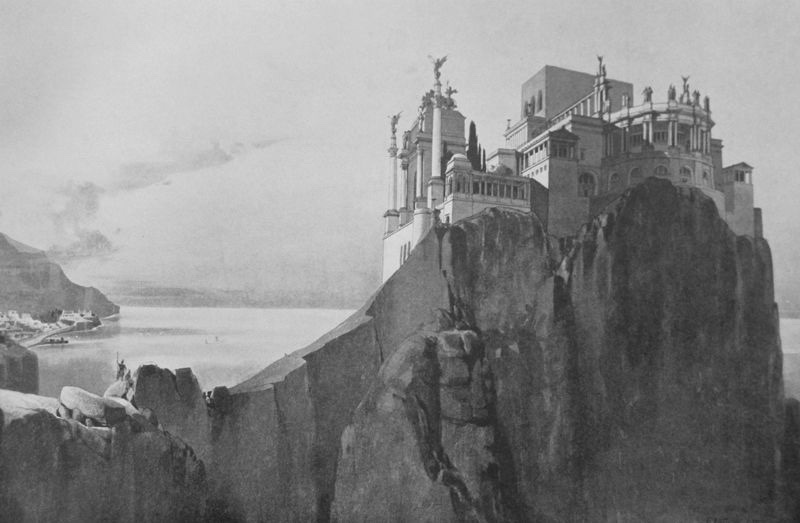
Most finds have been lost. Others, however, are preserved in the halls of the Archaeological Museum of Capri and in the Church of Santo Stefano in Capri (such as parts of the marble pavement).
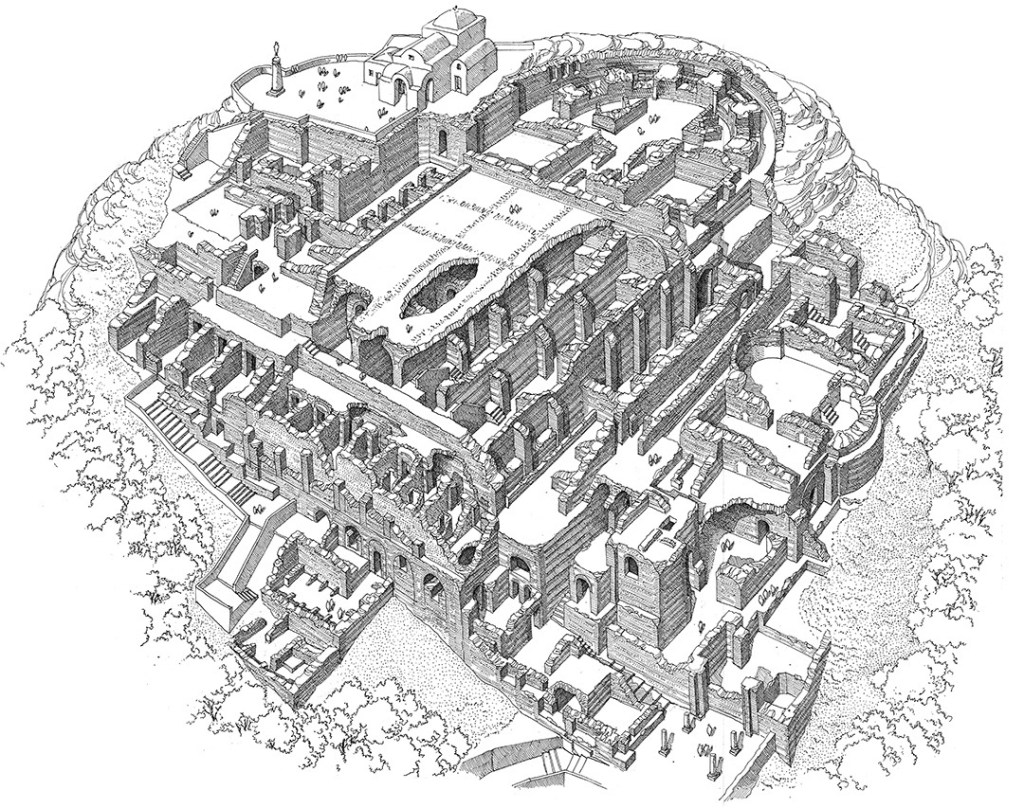
A drawing of Villa Jovis ruins by Francesco Corni (Reproduced with the kind permission of Fondazione Francesco Corni ©)
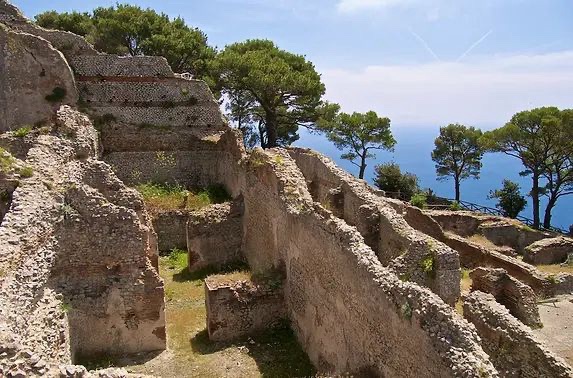
The archaeogical complex was inaugurated in 1937 after the extensive works by Amedeo Maiuri: the ruins clearly indicate sections linked by corridors, stairs and passageways. “The myth of Tiberius”, Maiuri said before the excavations, “lived again in that wild and deserted solitude, and men and nature seemed to conspire to make his name more execrable”.
Built on the top of the island’s eastern headland, 334 metres above sea level, the palace was immense: 7,000 square meters of buildings, 13,000 square meters of park with terraces and nymphaeums scattered over 40 meters of altitude.
The palace followed the very nature of the land. No porticoes and gardens inside, but stairs and ramps to climb from rock to rock and large and small loggias, to enjoy the infinite and changing panorama of the gulf.
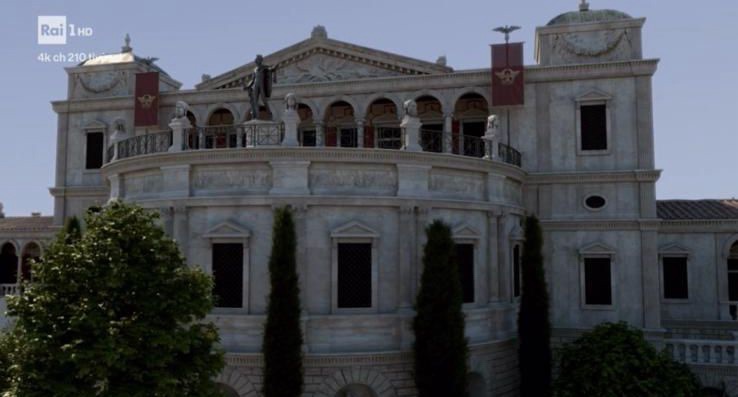
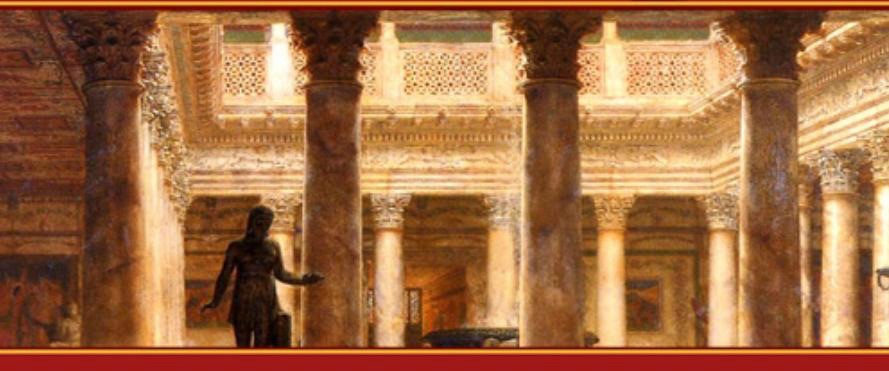
At the top of the palace a huge peristyle, overflowing with the most precious marbles, surrounded the great imperial reception hall and the emperor’s quarters.
Hundreds of rooms housed the offices for the government of the empire and the lodgings for the court, the soldiers and the servants. Overlooking the gulf, the large exedra. From that terrace, suspended between the sea and the sky, Tiberius tried to listen to the voice of his destiny.

The wide flights of stairs rose from the so-called “viale dei mirti” (myrtle alley) and ended in the large vestibule followed by a tetrastyle atrium with four white marble bases, on which stood four cipolin marble columns.
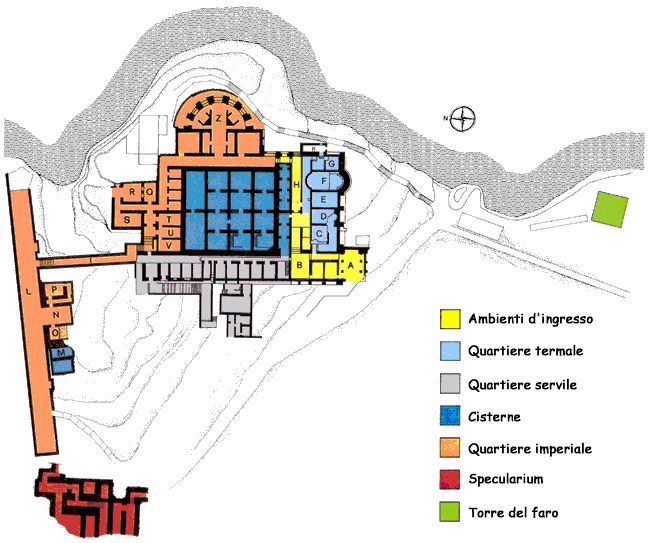
Adjacent rooms accommodated the guardhouse, while a wide corridor with a white mosaic floor led to a second vestibule, from which there was access, to the east, to the upper floor, occupied by the baths and living quarters.
The bathing facilities, extending along the entire side of the palace, consisted of a series of five rooms parallel to the corridor: in the calidarium, used for hot water baths, there are two apses, one with a basin and another with a bronze basin for performing ablutions.
At the center of the large structure were the cisterns for the collection of rainwater. Water in this area was so scarce that space had to be found specifically for these tanks, which were also used for the thermal system.
The west side consisted of a multi-storey building for servants, with identical rooms arranged along a corridor.
The Emperor’s private quarters, located on the top of the mountain and facing north towards the interior of the island and west towards the sea, were secluded from the rest of the palace.
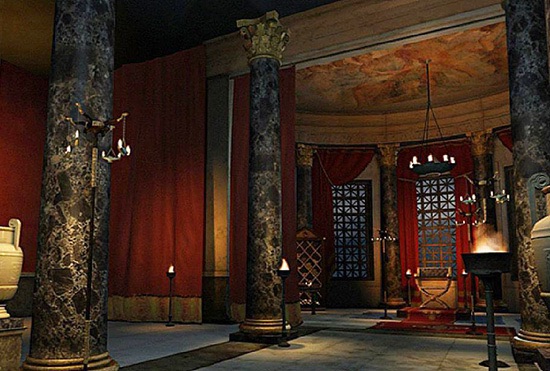
The accommodation consisted of three rooms: an entrance vestibule, with a canopied terrace in front, and two rooms with large windows and polychromatic marble inlay floors. This is where the emperor and his most trusted collaborators, such as the astrologer Thrasillo, slept. The eastern side was occupied by the throne room.
The residence was accessible only by land through a narrow passage always well guarded by many soldiers.
There is a legend that there was even a secret underground passage, an escape route connected to a bay where a boat was moored ready to rescue Tiberius in case of need.
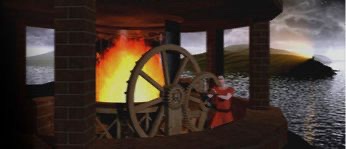
Through communications from the Senate, police reports, his network of spies and letters from friends and relatives, and thanks to a lighthouse used for communications with the mainland, from Villa Jovis the emperor controlled everything.
Thus the historian Gregorovius: “From here Tiberius saw everything that took place on the island and also spotted the ships that came from Hellas, Asia, Africa, or arrived from Rome”.
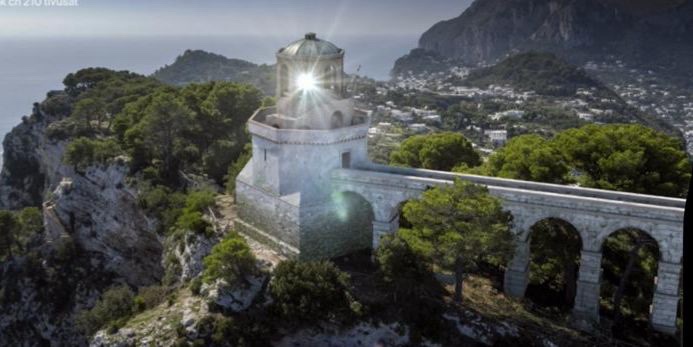
The optical communications service, implemented by means of a secret code with smoke during the day and with torches at night, was entrusted to a special body of lookouts. On the coast of the Gulf of Naples there was this system of towers for optical communications and fast liburnes (small galleys) that allowed the emperor to quickly receive messages and give orders.
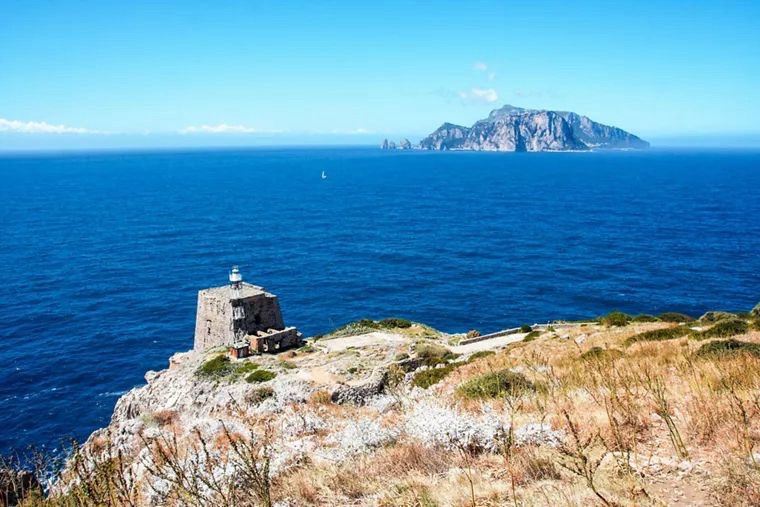
According to historian Suetonius, the lighthouse collapsed a few years after Tiberius death, due to an earthquake, and was rebuilt during the Flavian age.
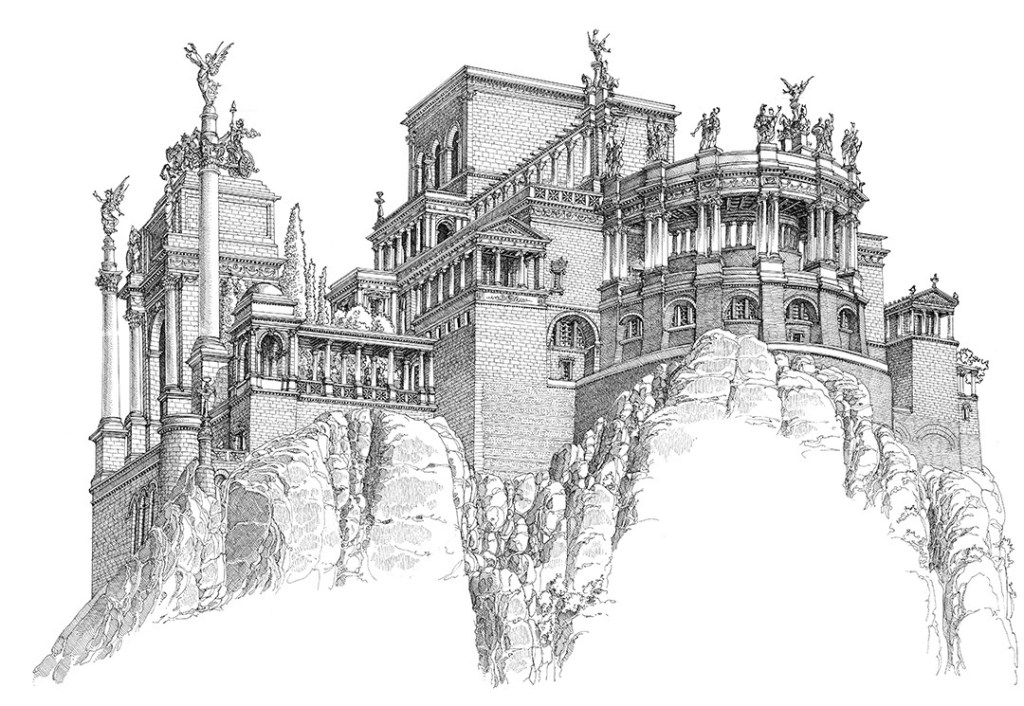
Villa Jovis offered a fantastic terrace with the triclinium room and a belvedere that dominated the entire island and from where you could admire the Gulf of Naples, a curve that goes from Cape Miseno, with the islands of Ischia and Procida, to the Sorrento coast, the Amalfi coast and Cilento.
Tiberius spent entire days in Capri in total solitude, even renouncing the presence of his guards, his servants and the imperial secretaries, dedicating himself to solitary walks along the belvedere of his villa. On his terrace Tiberius had laurel trees planted, because he believed that during storms lightning would not strike them.
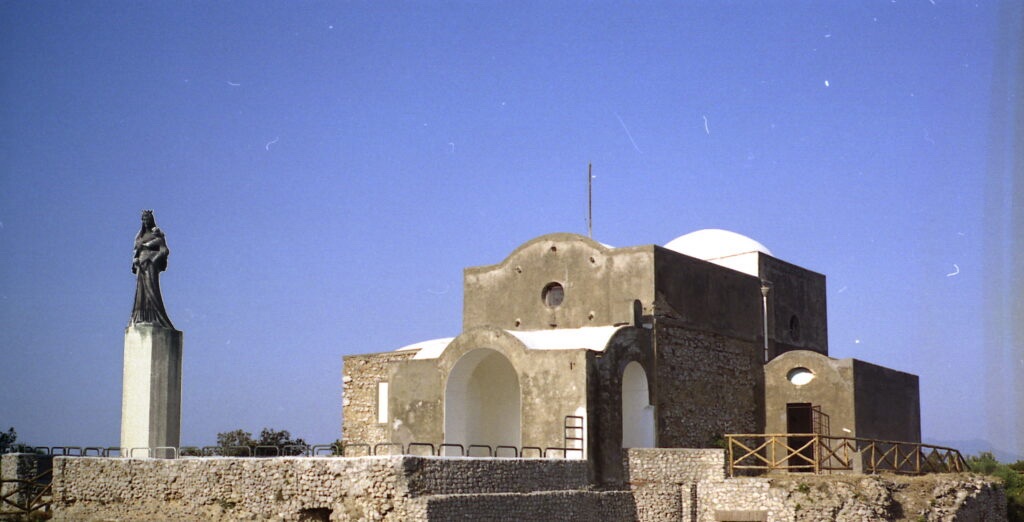
From his fantastic imperial loggia Tiberius launched the fashion of the aperitif, in fact shortly before sitting down for meals he had the habit of drinking wine on an empty stomach to stimulate his appetite.
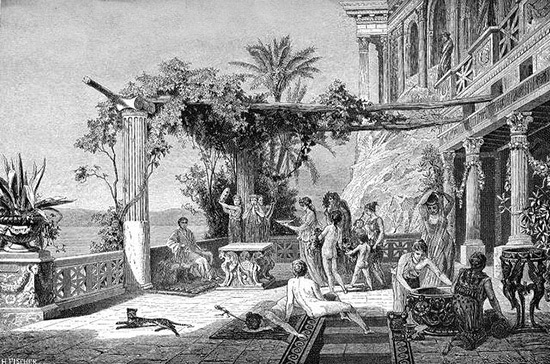
On his table there were fruit and vegetables, pears, raisins, cabbages and cucumbers. He had a real passion for these, he ate them daily, he had special boxes built with wheels in which he grew them, so that in winter he could move the plants to expose them to the sun.
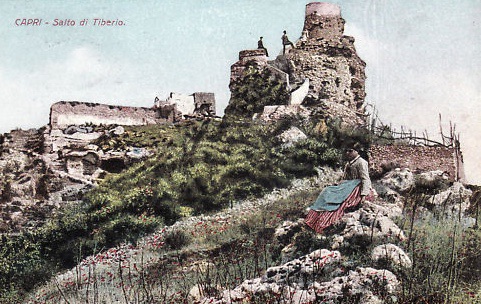
Not far from the imperial lodge, almost suddenly the abyss: a 297 meter cliff overlooking the sea, called the “Carnage of the Monster” or “Tiberius’ Leap” where it seems that Tiberius enjoyed watching while his enemies, lovers and those condemned to death were thrown. Any survivors would then finished off in the sea by sailors with harpoons and sticks. The first said to have experienced the horrible ravine? A young fisherman who had sneaked into the house, escaping surveillance to donate a mullet to the Emperor.
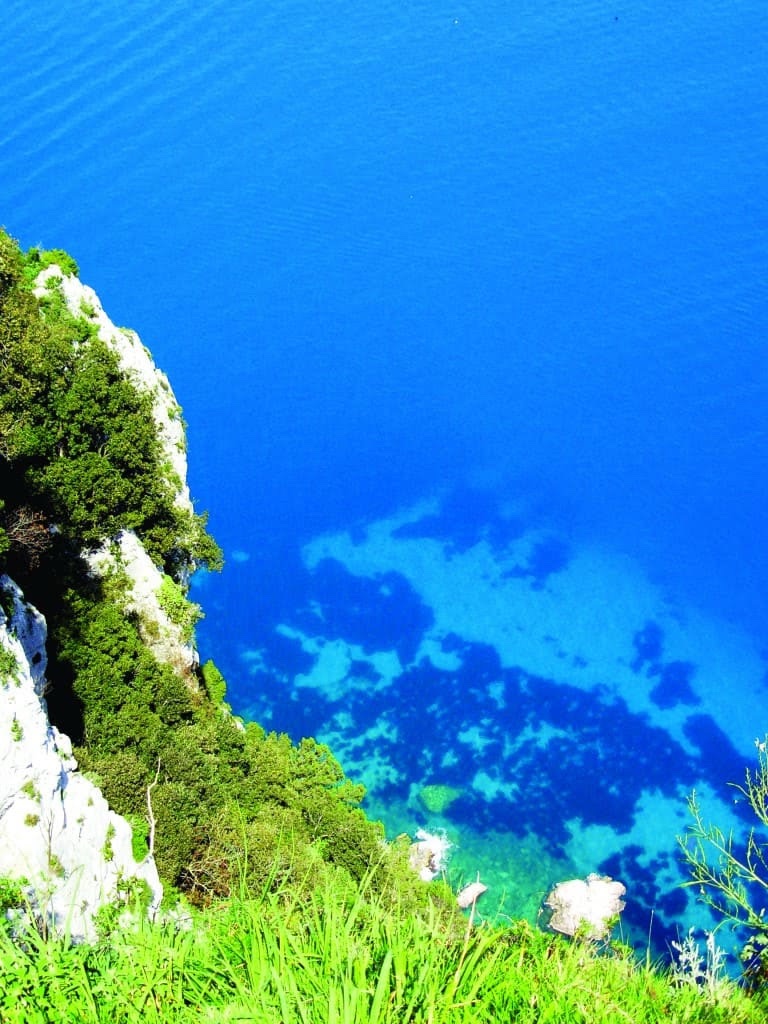
As wih many other legends about Tiberius, though, this one has been disputed. It has been proven that a body thrown from that cliff would not fall directly into the sea below, but would end up crashing onto the rocks along the way.
History and myth of Tiberius are strictly interconnected in Capri and today it is impossible to speak of the island without mentioning the Emperor or to narrate Tiberius disregarding Capri, the haven of his final 11 years that thank to him has its place in history books.
History and Roman Legacy
Capri is made up of a single block of limestone with an area of 4 square miles, rising to 1,932 feet. The etymology of the island name, Capri, has several meanings. The Romans referred to it as the “goat island”, from the Latin caprae meaning goats. This is similar to the Ancient Greek kapros meaning “wild boar”.
The island was first “discovered” by emperor Augustus in the early years of the Roman Empire. He arrived on the island in 29 BC after the battle of Actium, and he chose to build his palace on the northern side due to its proximity to the landing place and its location in the shade. Augustus had many temples, villas and gardens built in Capri.
Modern excavations, however, show that Capri was inhabited long before the Romans: it was the Greeks who settled on the island from the 8th century BC onwards, as clearly shown by the ‘Phoenician steps’ (the old name is misleading) that connect Marina Grande with Anacapri.
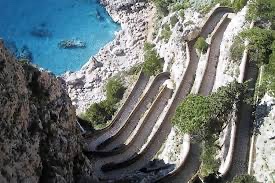
It remained a Greek colony until Augustus took it from the colony of Naples in exchange for Aenaria (Ischia), another island in the Tyrrhenian Sea.
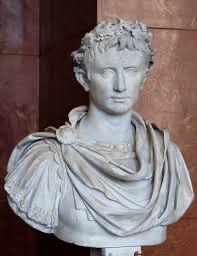
The legend says that Caesar Octavian (who had not yet given himself the title of Augustus) was travelling back from the eastern dominions, in 29 BC, when he landed on the island of Capri. Here he saw a very old oak tree that, little by little, began to come back to life and became green and lush again. A favorable sign, narrated by Suetonius, that convinced Augustus to make Capri a dominion of Rome. He called it Apragopolis, the city of sweet idleness and he built his residence and new infrastructures in the island.
The Romans discovered evidence of human settlement, which Augustus ordered to be displayed in his garden. Modern excavations of Augustus’s villa have traced weapons and animal remains dating back to the Neolithic period and the Bronze Age.
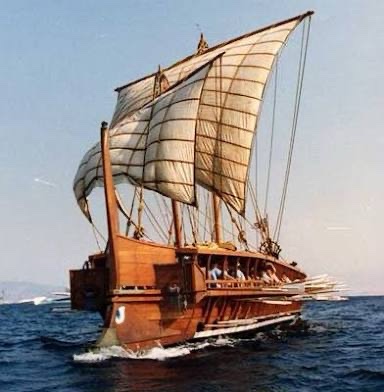
It was the spring of 26 AD when, aboard a fast Esareme, probably the Ops, the Emperor Tiberius Julius Caesar Augustus arrived on the island of Capri to stay there until the end of his days. The island was then a mountain in the middle of the sea, inhabited by Greek people, covered with laurels, myrtles, orange groves,. An island that made any attacks by sea difficult, which had no ports but only natural and guarded landing places like that of Tragara (between the Faraglioni and the Monacone rock).
Tiberius chose to live in Villa Jovis, a villa situated at a secluded spot on the island, nestled in the north-east of Capri, hard to reach and heavily guarded.
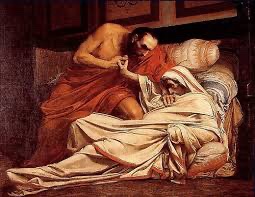
The rumours surrounding his death, however, imply that in the end precautions were not enough to save him. During a journey along the coasts of Campania and Lazio, in 77 AD, an illness forced Tiberius to stop in a villa in Misenum, where he died on March 16th. The cause of his death ranges from poison to smothering, as reported by Suetonius.
As for the island, Capri seems to have been little visited by other emperors. One century later, though, it was chosen by Emperor Commodus as the place where he sent into exile his sister Lucilla and then his wife, Crispina Bruzia.
Lucilla was the beautiful second daughter of Roman Emperor Marcus Aurelius and the elder sister of Commodus. In the movie Gladiator she is portrayed as a widow who had had a past romance with the main character Maximus (Russell Crowe), when they were young. She also has a role in Gladiator II.
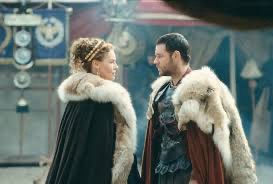
Annia Galeria Lucilla was exiled to Capri in 182 AD with her daughter and another woman after a failed attempt to kill her brother Commodus by her husband Quintilianus. In the island she lived in the area of the Villa of Augustus in Punta Bevaro, near Bagni di Tiberio. After a few months the three women were assassinated by a centurion sent by the Emperor.
In 192 AD Crispina Bruzia, wife of Commodus, was accused of adultery and exiled to Capri; on December 31 of that year Commodus himself was assassinated, and the same fate befell Crispina the following year.
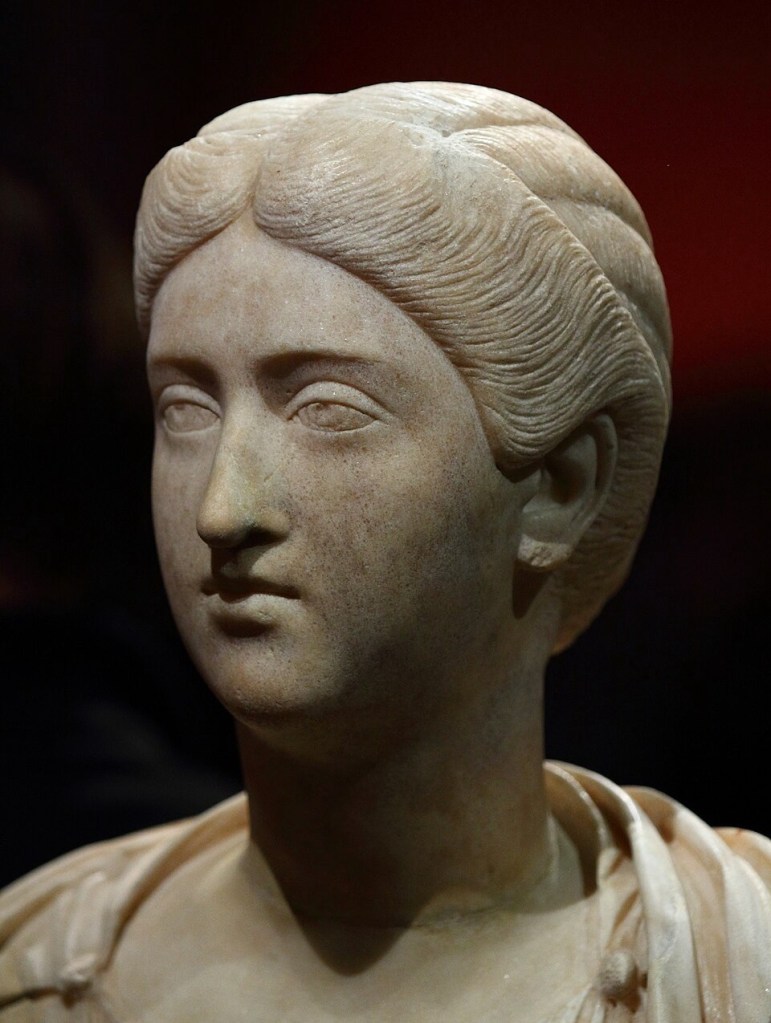
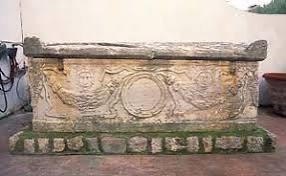
In 1810 on the island French soldiers of Joachim Murat found a sarcophagus in marble in the church of San Costanzo (Marina Grande) with what are believed to be the remains of Crispina.They opened it and it contained the skeleton of a woman wrapped in precious fabrics and with a coin of Vespasian in her mouth (the obol of Charon, the ferryman who carried souls across the River Styx to the under world). The sarcophagus has now been found in the terrace of a a holiday house in Capri and it may be returned to the church or displayed in the Archaeological Museum.
The Roman Imperial left behind many ruins which could still be seen in the 19thcentury and can tell us a little more about the island and its inhabitants. Numerous ancient cisterns for example, show that in Roman, as in early modern times, rainfall was used to provide the island with water, since it has no natural springs.
Roman Itinerary
Of the 12 villas believed to have been in Capri under Augustus and Tiberius, only three are proved to have been Imperial residences: Villa Jovis, Augustus Villa (Palazzo a Mare) and Villa Damecuta in Anacapri.
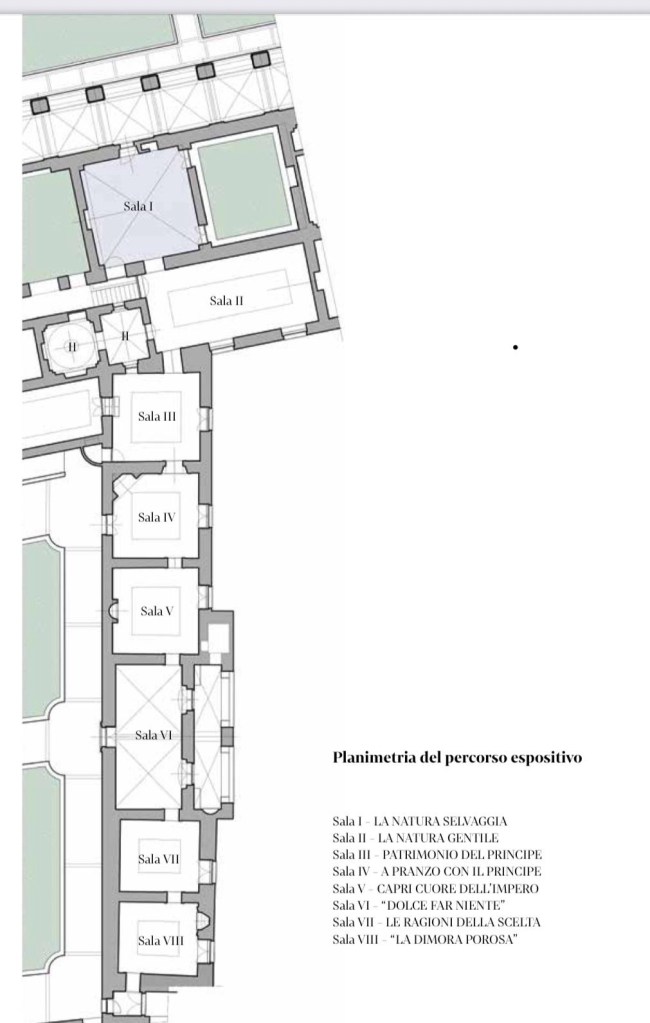
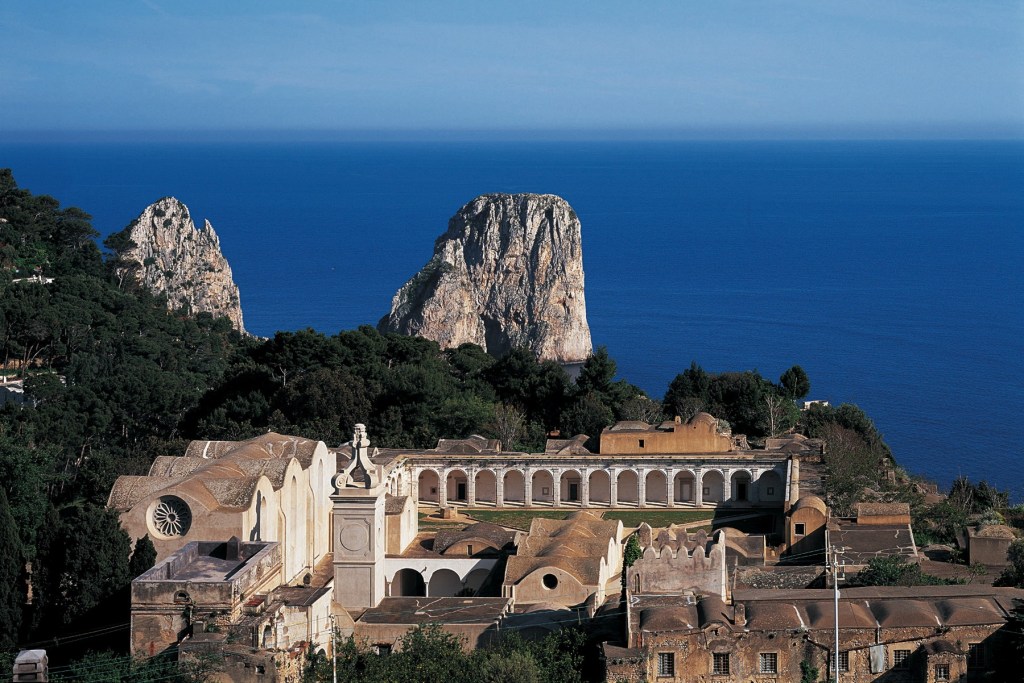
Capri Archaeological Museum – In the spaces of the Quarto del Priore in the Certosa di San Giacomo (Charterhouse of St. James), the new Archaeological Museum of Capri was inaugurated in 2024. The museum narrates the island’s history during its heyday, at the time of emperors Augustus and Tiberius, through an eight-room itinerary.
The museum displays 120 finds and masterpieces from excavations carried out on the island of Capri, such as those of Villa Jovis, The rooms are set up with sculptures, ceramic and silver vessels and other architectural finds.
A touchscreen allows visitors to explore the 12 imperial villas recorded in ancient sources, offering information on their history and excavation.
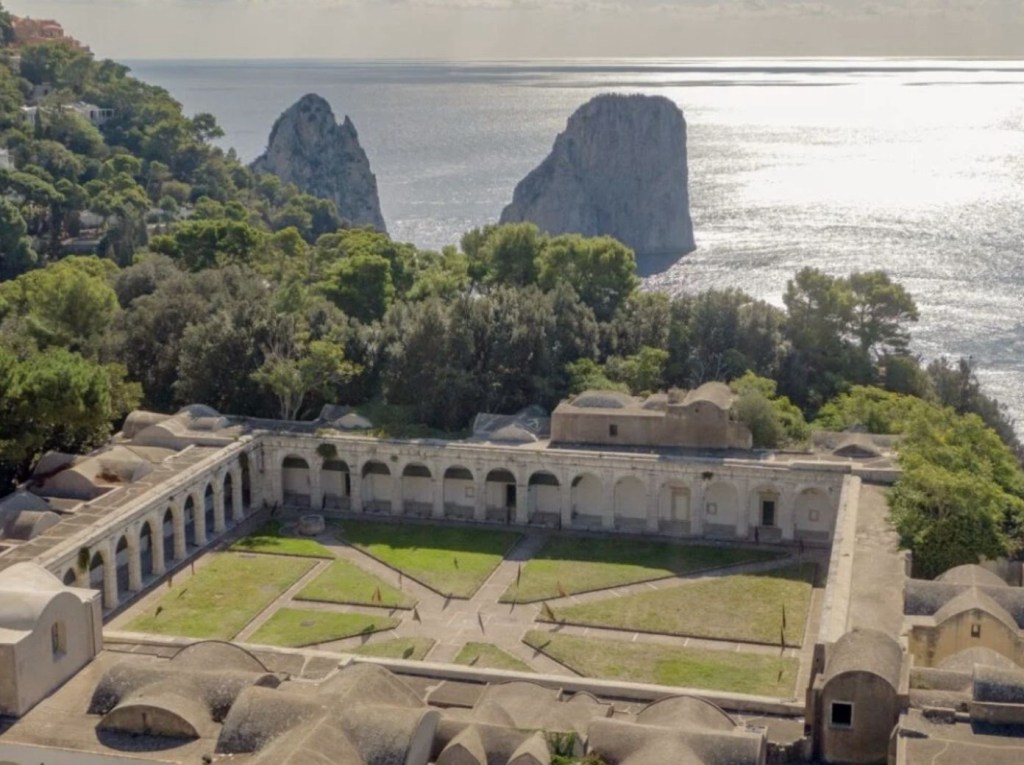
The layout is designed to highlight the continuous relationship with the sea, visible from every room in the museum.
The museum tour begins with a room dedicated to the wild nature of Capri, evoked by a majestic and solemn painting by Karl Wilhelm Diefenbach. The projection on the vault recalls nature today, linking the island’s past with its present.
The second room focuses on the Battle of Actium, following which Augustus founded a new political system in 31 BC. The third room shows the opulence and refinement of imperial residences through everyday objects and furnishings from the villas on Capri.
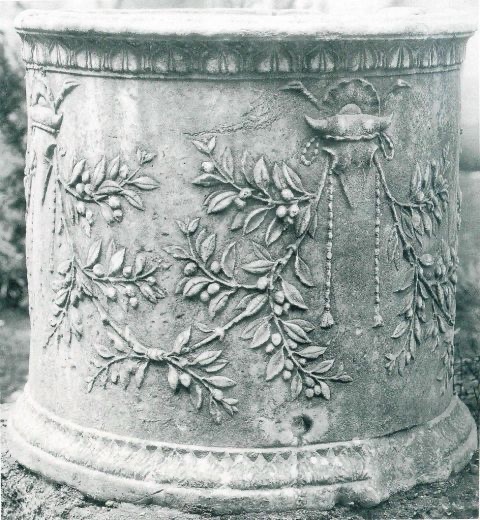
The fourth room displays a banquet offered by Augustus on the island. The Emperor loved Capri for the beauty of the landscape, the gentle climate, and its aura of sacredness and Greek tradition.
The fifth room is devoted to the domus Augusta. In this section, family ties and the management of Augustus’ personal wealth are intertwined with the management of the Empire. A gallery of portraits and a large family tree illustrate the complex family ties of the Julio-Claudian dynasty.
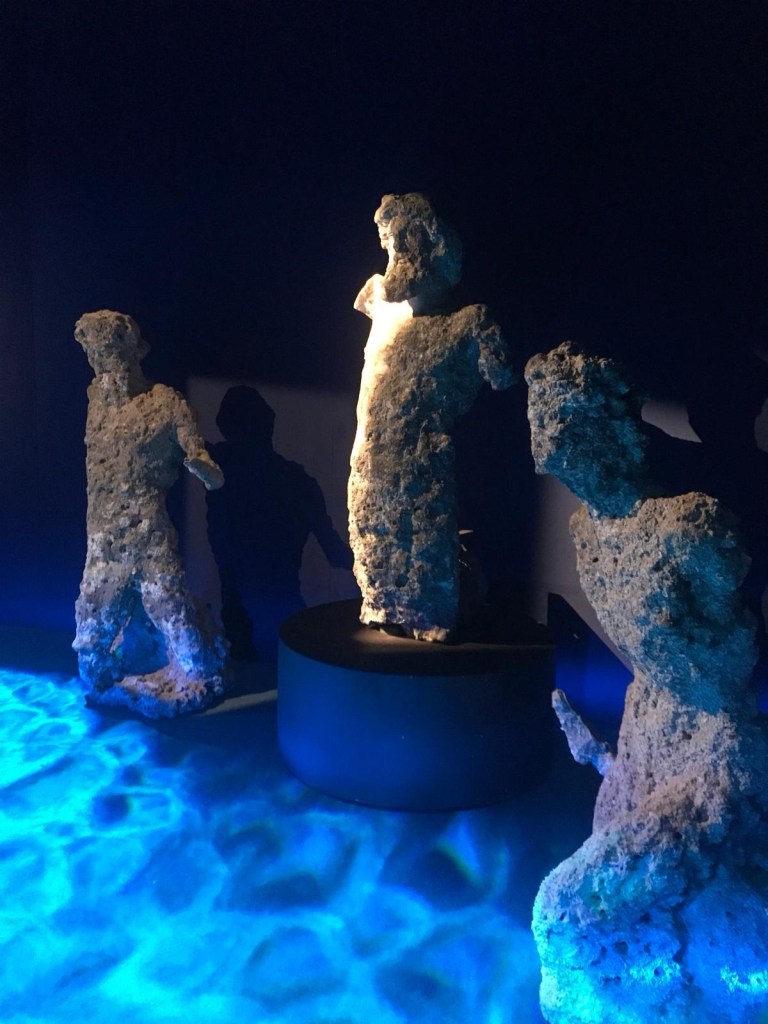
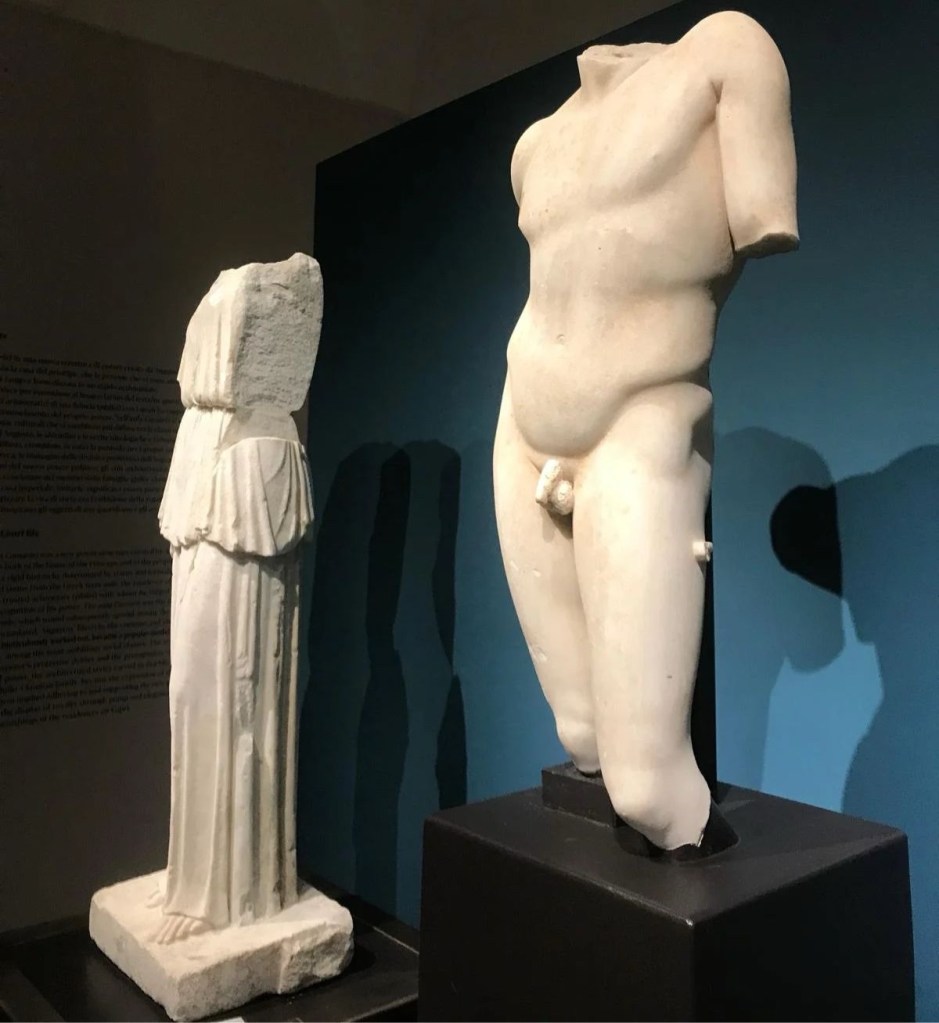
Augustus Villa (Palazzo a Mare) – One of the most significanti Roman villas in Capri is located in the nothern area of the island known as Palazzo a Mare.
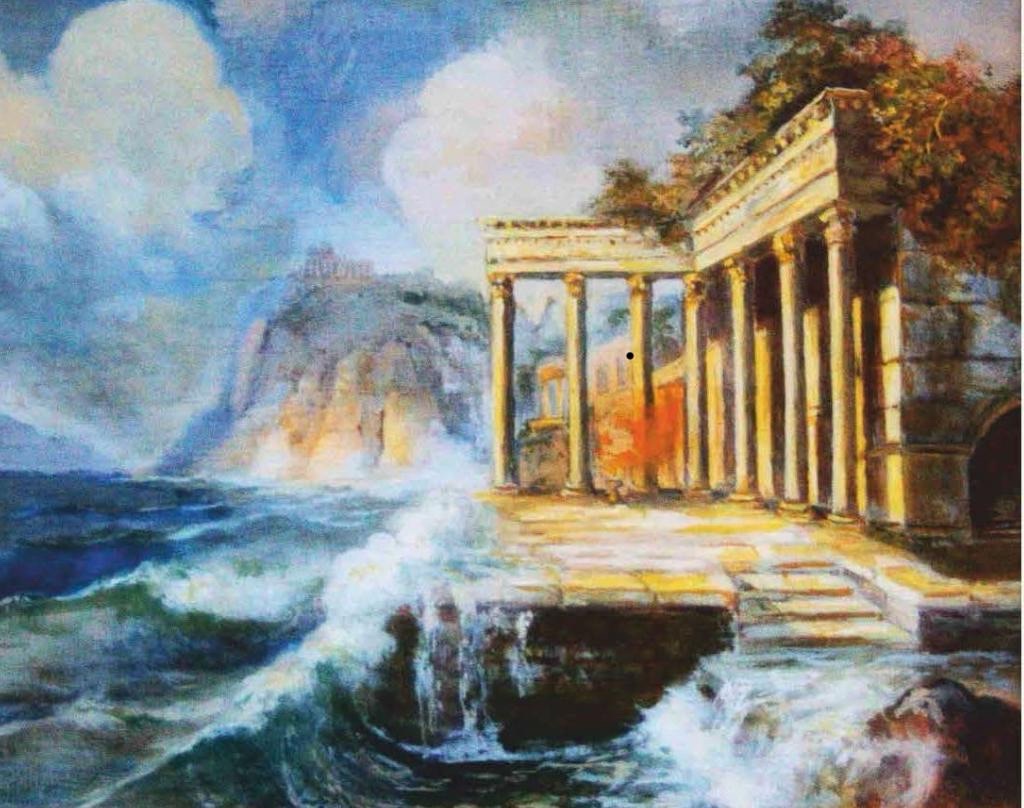
The Palatium extended for 850 metres over a vast area that goes from Punta Bevaro to the beach known as “Bagni di Tiberio“, arranged in various nuclei between the sea and the promontory, in the typology of the maritime villa characterized by scattered architectural elements, in a panoramic position.
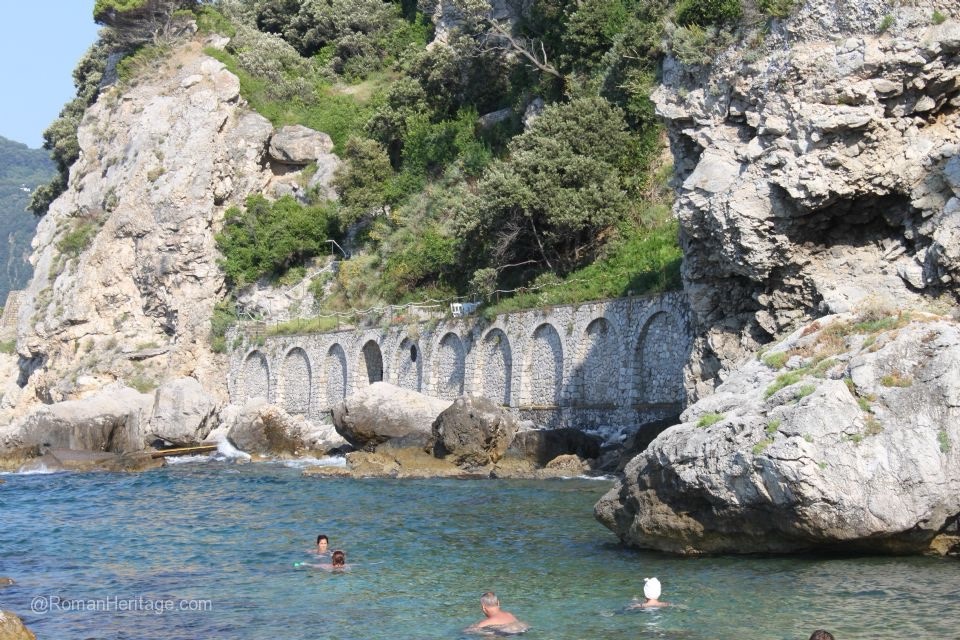
The villa, attributed to Augustus with subsequent renovations ordered by Tiberius, was excavated and robbed of floors, capitals and marble slabs. Of the ancient imperial residence nothing is left but fragments of terrace walls, some cisterns and scant remains of the residential quarters.
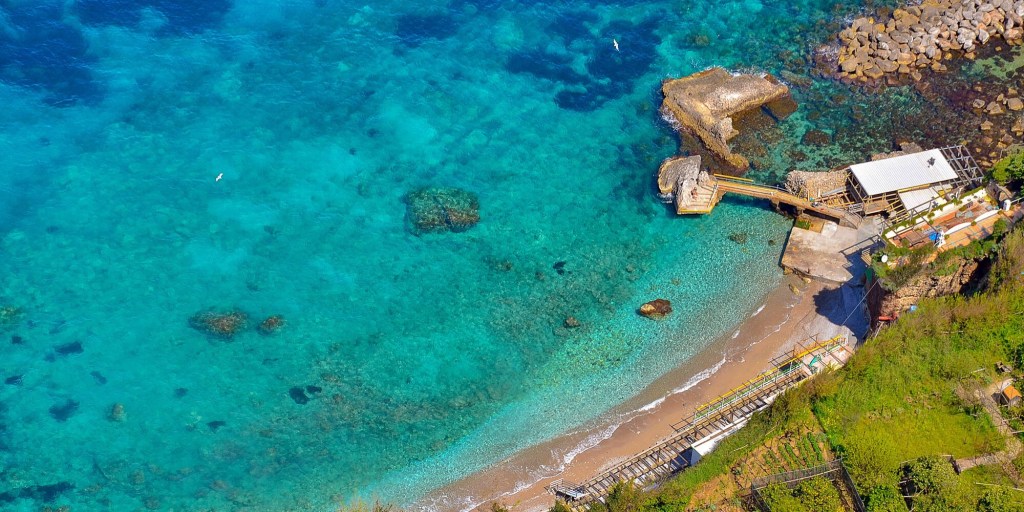
The picturesque little beach of gravel mixed with sand is overlooked by a high cliff that protected the ruins. It is now occupied by a bathing establishment (Bagni di Tiberio) that can be reached more easily by sea with a boat service from Marina Grande or by land from a small road (Via Palazzo a Mare) that starts near the old Basilica of San Costanzo and the football stadium.
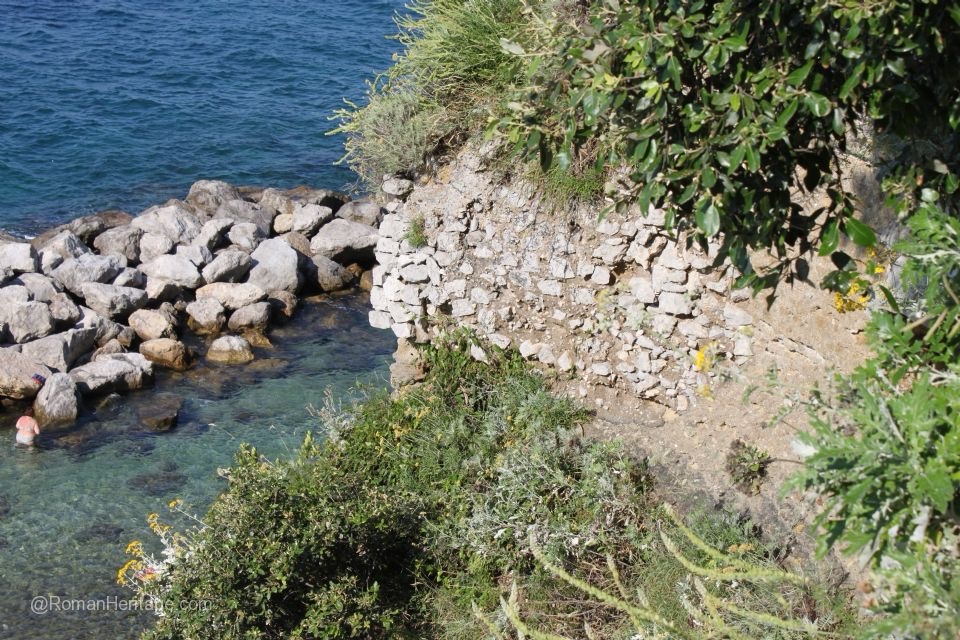
From the original villa, very little remains today: a large exedra, perhaps a semicircular nymphaeum, which opens onto the sea, flanked by an important wall to protect the ancient remains, the remains of some pools and a small pier that gives access to the gravel beach and the bathing complex.
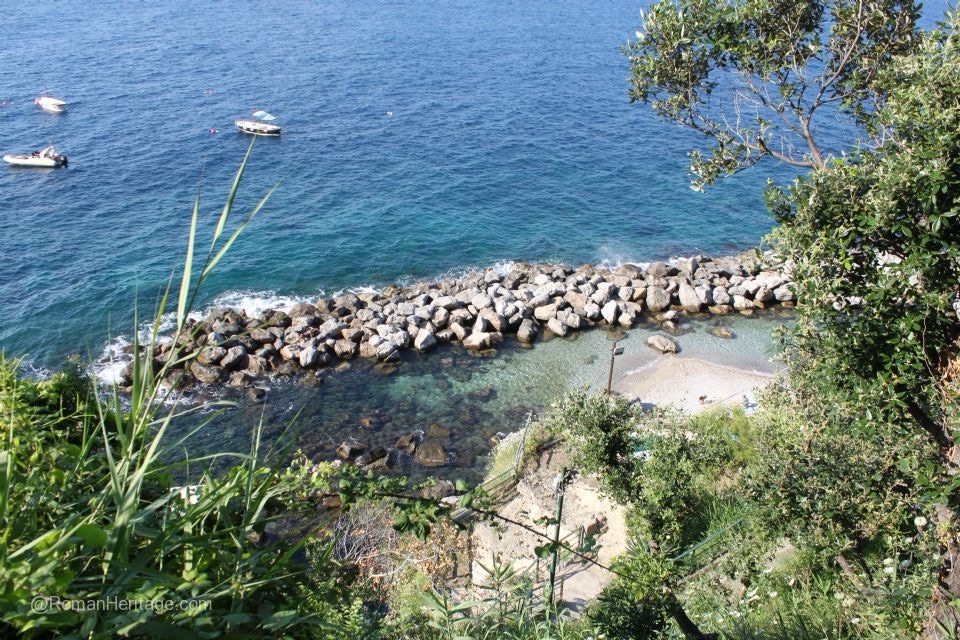
These are the only currently visible evidence of what was the maritime district of the large imperial villa. Upstream of this district were located the tanks for collecting water, the gardens, the servants’ quarters and the royal apartments.
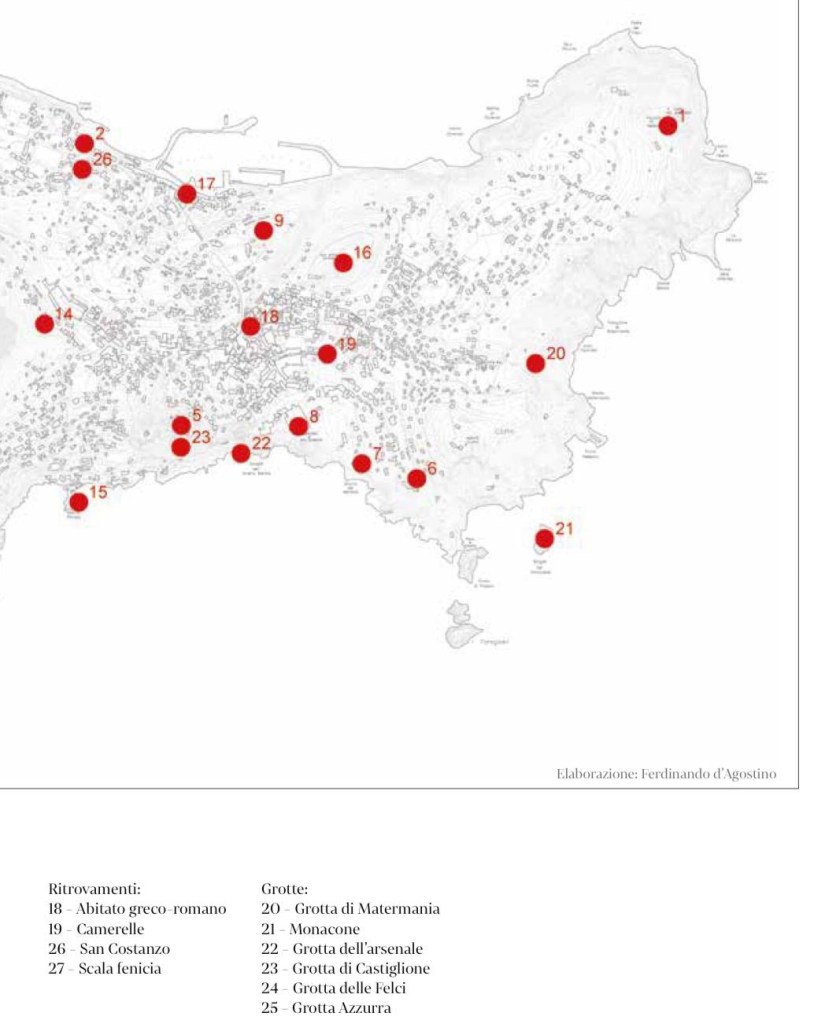
The ‘Roman caves’, Grotta Azzurra, dell’Arsenale and Matermania –
The Blue Grotto (grotta azzurra in Italian) is a sea cave located on the northwest coast of the island of Capri, in the municipality of Anacapri.
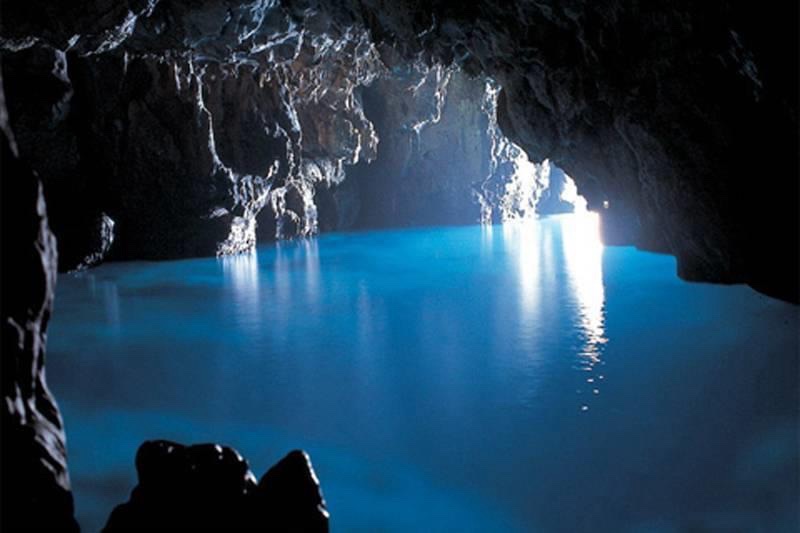
It is famous worldwide for its clear water and its bright blue reflections that come from the external light that enters through a crack and is reflected by its walls.
It is a natural karstic cave approximately 60 meters long and 25 meters wide with a depth of 13 meters. The ceiling rises from 7 to 14 meters. The entrance is 2 meters wide and only 1 meter high.
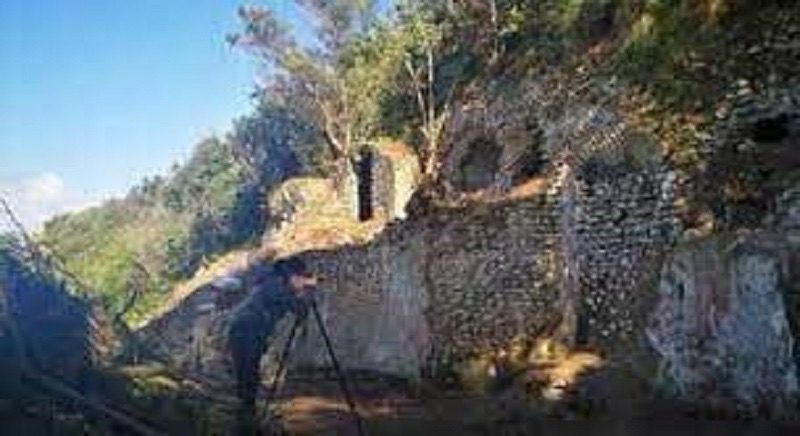
In Roman times, during the reign of Tiberius, the cave was used as a maritime nymphaeum. The cave, in fact, constituted a true underwater appendage to an Augustan-Tiberian villa called Gradola, today reduced to a few ruins.
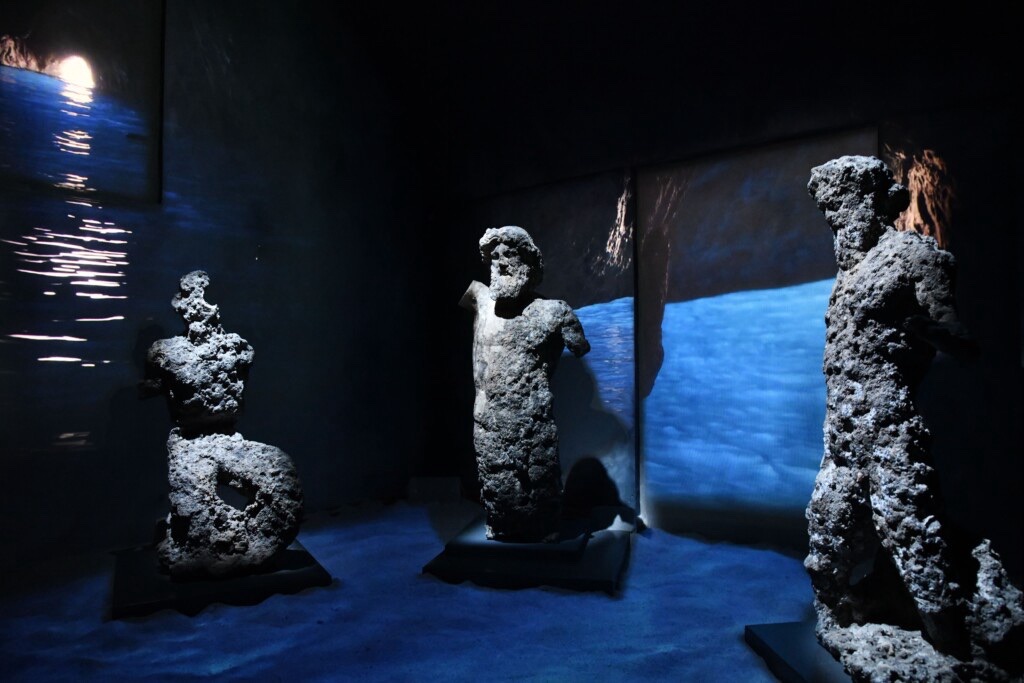
Evidence of this use are the numerous Roman statues, representing Poseidon, a triton, and other marine creatures that must have originally been arranged along the walls of the cave. The statues are now kept in the Casa Rossa Museum in Via Giuseppe Orlandi, 78 at Anacapri that is worth a visit also for its Roman artefacts from Villa Jovis and Villa Gradola.
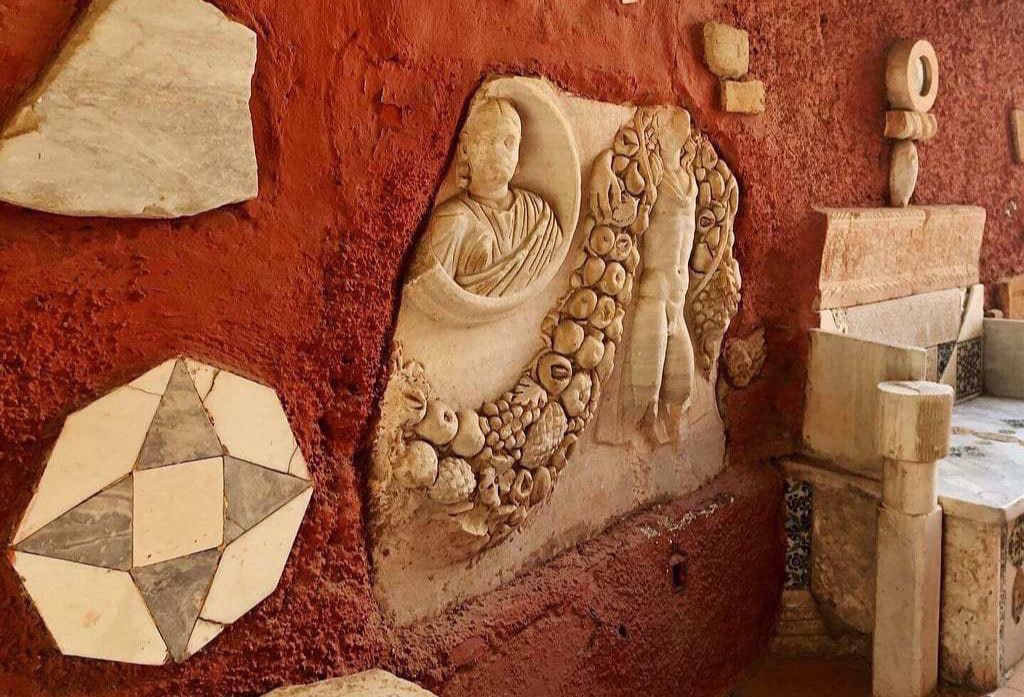
“It seemed that I had entered the house of Glaucus and his cerulean retinue of Nereids, and that no artificial maritime nymphaeum covered in marble and mosaic work could equal it in beauty”, wrote archaeologist Amedeo Maiuri of the Blue Grotto.
Grotta dell’Arsenale is located between the charming little port of Punta Tragara and the small beach of Marina Piccola, towards Scoglio Unghia.
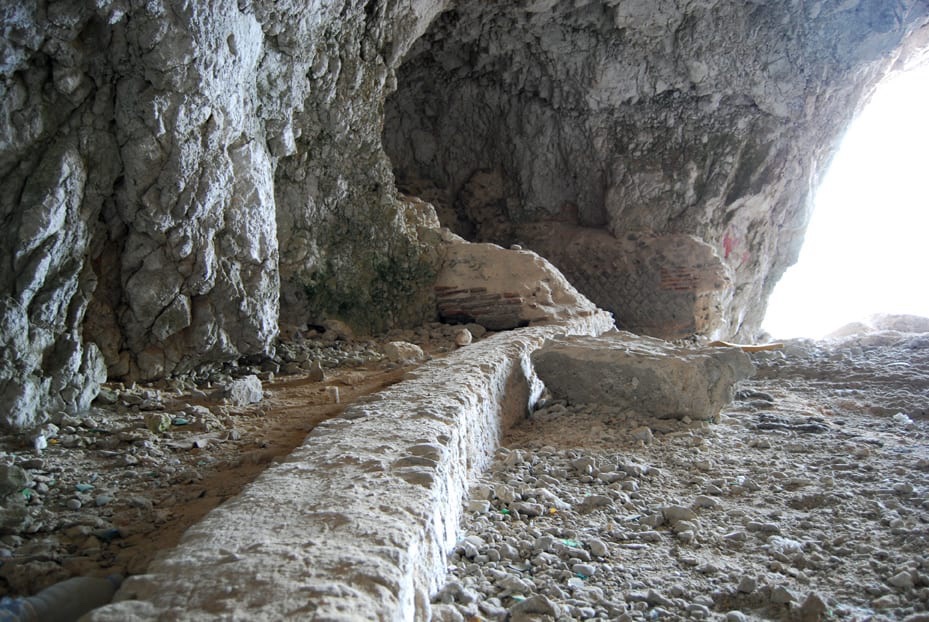
It is overlooked by a series of floral terraces, known as the Gardens of Augustus. During the Roman era, Grotta dell’Arsenale was one of the nymphaeums favored by Emperor Tiberius as a pristine place where he could spend moments of relaxation far from the duties and responsibilities of imperial life.
The cave’s wide entrance, elevated approximately 4 meters above the ground, leads to a circular interior space 37 meters deep. During excavations in 1979, fragments of a gray and black checked floor and a series of stunning multicolored mosaics that once adorned the cave’s interior walls were discovered.
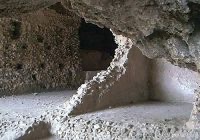
Around the large central cavity thereare several rooms with partially preserved linings of opus reticulatum and brickwork and a cocciopesto surface, dating back to the Roman period. On the left wall of the main room are six niches, another six must have been on the opposite wall, of which three remain, plus a fourth in poor condition.
The Grotta di Matermania was artificially reshaped during Roman times: it is located in the south-eastern part of the island, on the slopes of Mount Tuoro, along the Pizzolungo route.
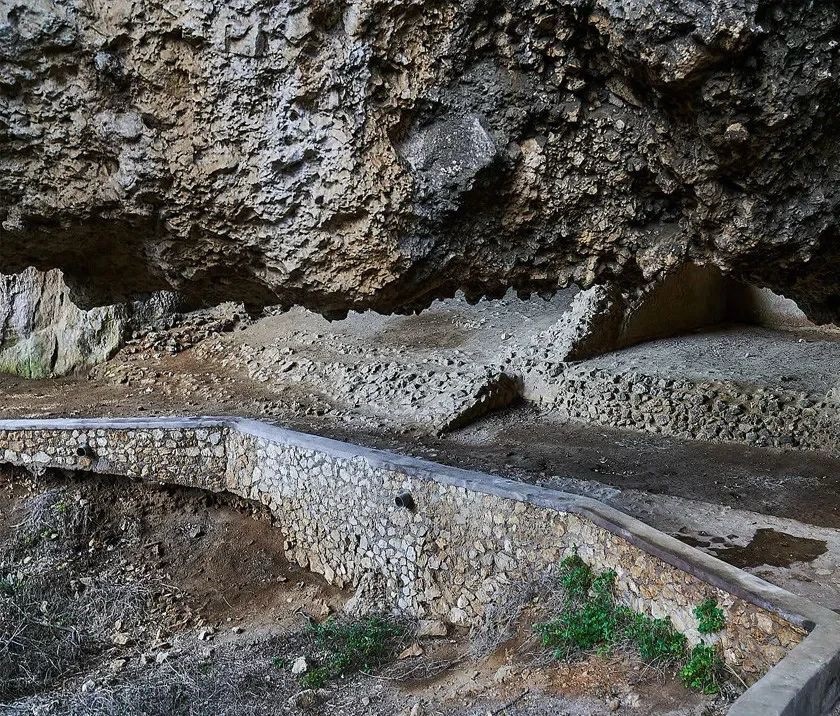
The cave can be easily visited by taking the Pizzolungo path, a series of steps which begin before arriving at the Arco Naturale, near the Le Grottelle restaurant.
The discovery of a terracotta statuette depicting Cybele, and of an altar dedicated to her, suggest the first meaning, since the divinity was identified as Mater Magna, the Phrygian goddess of nature and animals, to whom it seems that rites and sacrifices were reserved inside the cave. Another theory is that the god Mithra was worshipped here. The cave, though, might have been just a nymphaeum like many other grottoes on Capri.
The interior is divided into two rooms, a rectangular apse room with two superimposed podiums and the other, smaller, oval-shaped room; both still bear traces of the pictorial decoration.
Made of loose and unstratified limestone, the cave has been eroded over the centuries and today it has a semicircular shape, it is about 30 meters long, 20 meters wide at its maximum and it has an average height of 10 meters.
Damecuta Villa – On the northwestern promontory of Anacapri, the Damecuta plain is home to the Roman villa with the same name. It is one of the 12 Villas Built under Tiberius and probably the closest to a docking area.
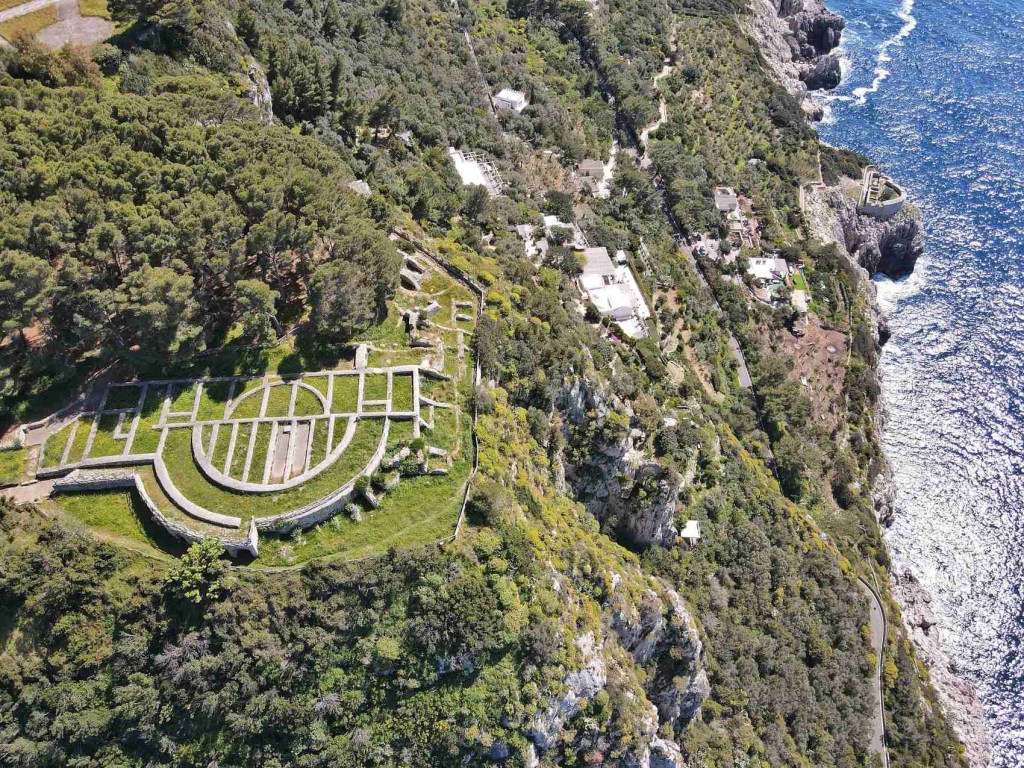
To arrive at Villa Damecuta, starting from the town of Anacapri (Ana means ‘above’ in Greek), you need to reach Piazza della Pace, at the stop for the bus that connects the upper town with the Blue Grotto and Punta Carena. Ask the driver for the Damecuta stop. The area can be reached also by taxi or scooter.
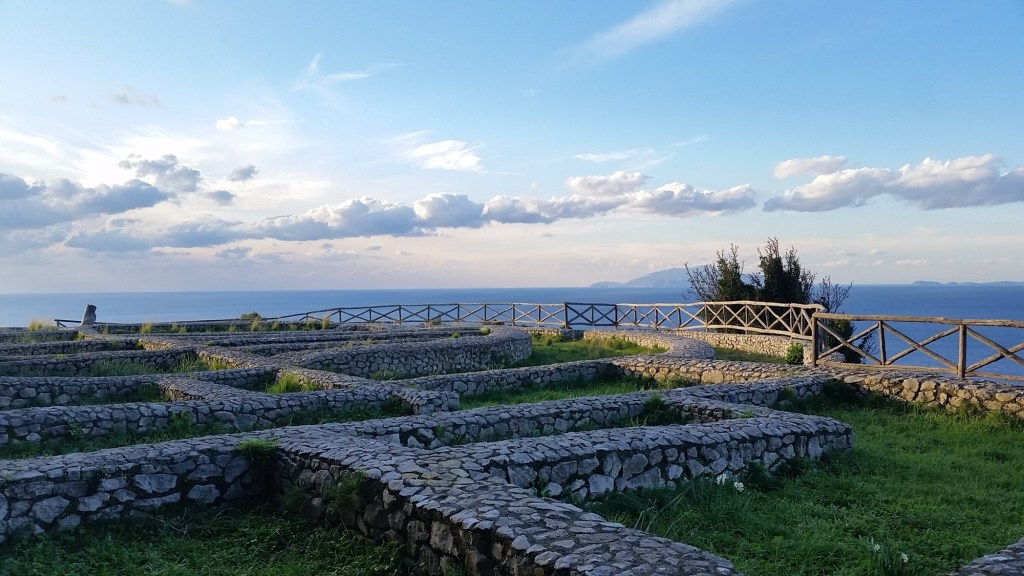
This Anacapri residence overlooking the sea allowed Tiberius to enjoy the unique panorama of the Gulf of Naples and its islands, completely surrounded by lush nature.
The ruins of Villa Damecuta, still visible today, give us an idea of what a luxurious and imposing palace it must have been, with marble floors, stucco, statues and refined decorations. Over the years, the building was first affected by the terrible eruption of Vesuvius in 79 AD, which led to the destruction of Herculaneum and Pompeii, and then by the foreign invasions.
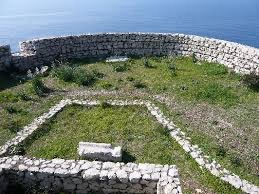
The building consisted of a porticoed loggia 80 meters long overlooking the sea, and a residential area near the western part, characterized by the presence of some benches right in the innermost area.
Damecuta Tower – Near the western end of Tiberius’ villa, 151 meters above sea level, the Damecuta Tower was erected around the 12th century. During the invasions by Saracen pirates on the island of Capri, the entire area of the imperial villa became a strategic point for fighting enemies.
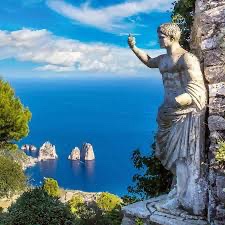
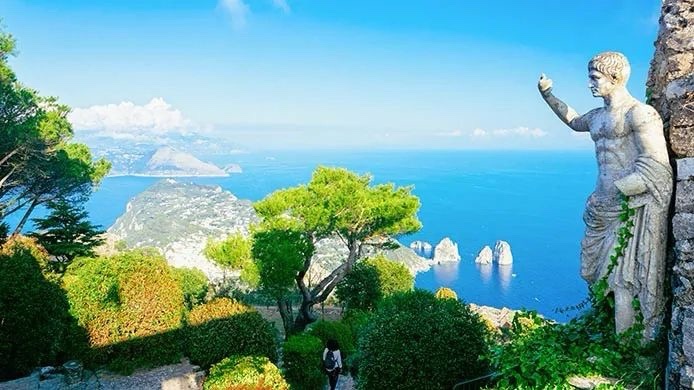
The statue of Augustus on the terrace of Caesar Augustus Hotel in Anacapri. It is a 19th century replica of the famous Caesar from Prima Porta. Russian Prince Emmanuel Bulhak chose it to dominate the view toward Villa Jovis.
Fun Fact – Tiberius, the Emperor who neglected Rome
Depicted for centuries as a cruel and degenerate despot, Emperor Tiberius Julius Caesar Augustus was in fact an able and shrewd ruler who, for several reasons, left a grim legacy. For the Roman author Pliny, he was the gloomiest of men. For historian Suetonius, traces of Tiberius’s savage and dour character could even be identified in his youth.
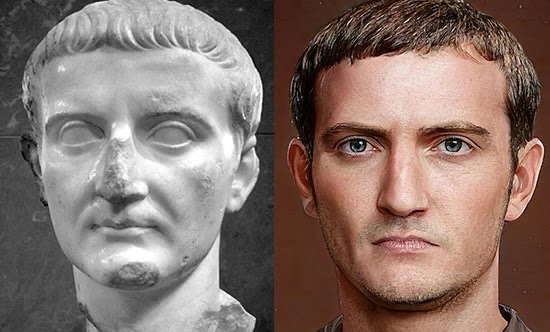
He was a strong defender of the Augustan tradition inaugurated by his adoptive father Augustus, the founder of the Roman Empire, and this firmness, combined with an introverse soul, contributed to his difficult relationship with the Senate. He ruled when the Emperor was not yet a fully acknowledged autocrat and he was therefore expected to exercise personal dominance through the old republican framework.
Of course, his decision to retreat from Rome to the island of Capri midway through his reign was difficult to accept for the Romans, it was as if an American president quit Washington to move permanently to Martha’s Vineyard. From what we know, Tiberius was uncomfortable in the role of emperor and yet he was a good one on many aspects. When he died, Rome was secure and solvent; he had been a highly respected military commander in his younger years, expanding and securing the boundaries of the Empire. He was fascinated by Greek art and culture, deeply immersed in philosophy and literature.
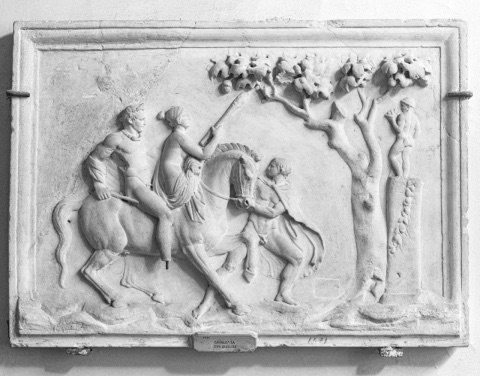
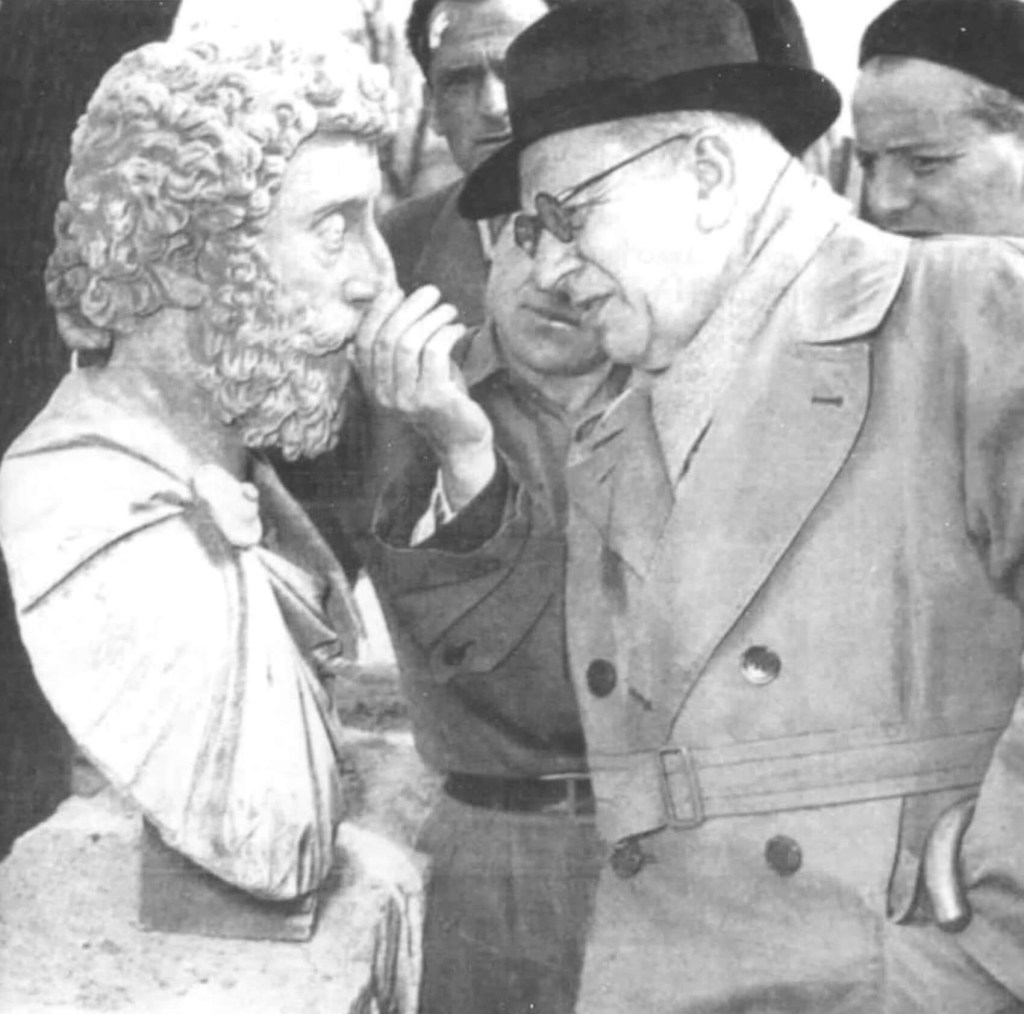
ride” from Villa Jovis (Museo archeologico nazionale di Napoli)
Tiberius difficult familial circumstances were probably the reason for his tough character: he was manipulated by Augustus, Rome’s first emperor, who chose him as his successor only when he was the last man standing; he was forced to divorce his beloved first wife, Vipsania Agrippina, and be unhappily joined to Augustus’s daughter Julia who repeatedly cheated on him; he was despised by his adopted daughter-in-law, Julia Livia, who may have helped murder his only son, Drusus the Younger, and he was deceived by the one man he thought he could trust, his closest ally, the powerful Praetorian Prefect Sejanus.
Yet we don’t know to what extent the vices and cruelty narrated by historians were real or legends. Suetonius wrote that in Capri he ‘finally gave in to all the vices he had struggled so long to conceal’, from drinking to a sex life that exceeded the worst perversions, with boys, girls, even tiny children.
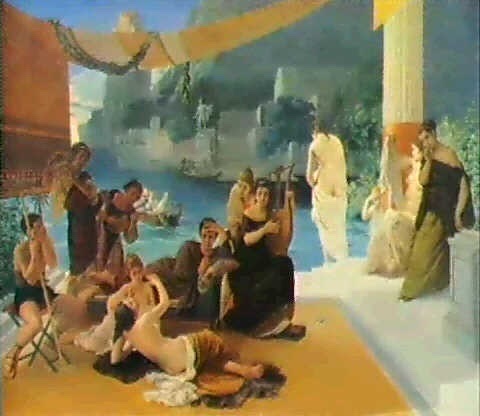
The cruel practice of having his opponents thrown into the void of a cliff, later named “Tiberius’ Leap”, was also part of this negative legacy. It is certainly true that in his final years Tiberius was obsessed with possible plots to kill him and he inaugurated a reign of torture and executions to stop real or imaginary conspiracies.
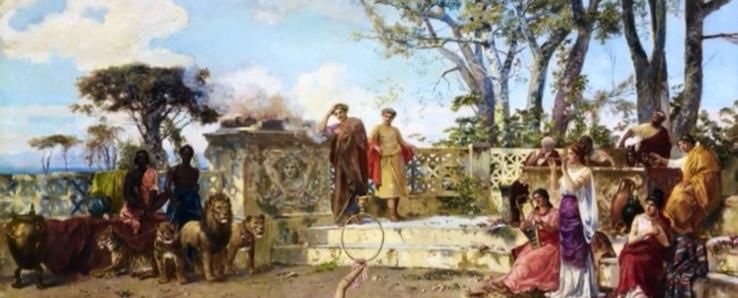
The days that Tiberius spent in Capri,for sure, were laborious. He carefully checked the new laws for Rome, and from his study every day he solved the problems arising from the Provinces of the Empire. Passionate scholar of literature and philosophy, he was surrounded by grammarians, bibliophiles, and calligraphers with whom he often conversed, and to whom he entrusted the care of the private library housed in his palace. In 31 AD Tiberius was joined in Capri by his adopted nephew Caligula who remained in the island for six years. When the Emperor died, in 37 AD, Caligula succeeded him at the age of 24.
Useful Informations for Capri
Villa Jovis – The Villa is situated at the end of Viale Amedeo Maiuri. From the Piazzetta, walk the length of Via Longano, continuing along Via Sopramonte and finally Via Tiberio. It’s an uphill walk and will take about 45 minutes.
Ticket price: Euro 6,00; free for European Union citizens under 18. Tickets can only be paid by credit card and debit card. You can buy them at the ticket office at the Villa or online
Opening Hours: it is advised to check opening times +39 081 8376218 (9am to 5 pm) or on its website. Villa Jovis is open year-round, but opening times vary by month. Generally, it’s open from 10:00 AM to 4:00 PM in March, November, and December. From April to May, and in October, it’s open from 10:00 AM to 6:00 PM. In June, July, August, and September, the opening hours are 10:00 AM to 7:00 PM. It is generally closed on Monday and in some periods on Tuesdays.
Museo Archeologico di Capri (via Certosa, 10) – It is located at the Certosa di San Giacomo. +39 081.8376218 Opening Times
Our Tabernae – Where to Eat
Restaurant and Pizzeria Lo Sfizio – via Tiberio 7e.
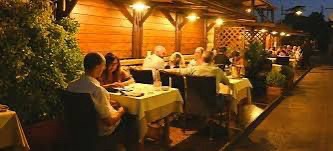
Walking along the little road that leads from the center of Capri to Villa Jovis, this restaurant offers home-style cooking in a relaxed atmosphere. Tra some traditional Capri recipes such as ravioli and pollo al mattone, along with the traditional pizza cooked in a wood-fired oven.
 Italy as the Romans did
Leave a comment